Affiliate Disclosure: BuyersChoiceLab participates in the Amazon Associates Program. We may earn a commission from qualifying purchases made through our links, at no extra cost to you. This supports our independent research and editorial work.
You’re staring at the Levoit Core 300S product page because you need clean air in a bedroom, nursery, or small office—but you’re tired of marketing claims about “99.97% filtration” that tell you nothing about whether this machine will actually clean your room fast enough to matter.
Here’s what you really need to know: the Core 300S delivers 141 CFM CADR (Clean Air Delivery Rate), which translates to effective coverage in rooms up to 219 square feet when you want five air changes per hour. It runs whisper-quiet at 24 dB on Sleep Mode, costs approximately $60–80 per year in replacement filters, and includes smart scheduling through the VeSync app—but it has real limitations around odor control and large-room performance that most reviews gloss over.
In evaluating this purifier, the BuyersChoiceLab team focused on translating spec sheets into real-world outcomes: how loud it actually sounds in a bedroom at 2 AM, whether the app features save you time or just add friction, what filter lifespan looks like in a home with pets versus a dust-free apartment, and which competing models deliver better value if your priorities differ from Levoit’s design target.
This review strips away the SEO-optimized feature lists and gives you decision-grade information. We’ll cover CADR-based room sizing math, measured noise levels across all four fan speeds, the real cost-per-year of ownership including filters, which app features actually work reliably, and—critically—when you should skip the Core 300S entirely and buy something else.
If you’re building a comprehensive air quality strategy across multiple rooms, start with our complete indoor air quality guide to understand whole-home planning before optimizing individual units.
Quick Answer: Should You Buy the Levoit Core 300S?
Best for: Single bedrooms (150–219 sq ft), nurseries, home offices, and small apartments where you want smart scheduling, quiet operation under 30 dB on low speeds, and reliable particle filtration without spending $300+ on premium brands.
Skip it if: You have open-plan spaces over 250 sq ft, need serious VOC/odor control beyond basic carbon adsorption, want to run a purifier on low speed in large rooms (the 300S lacks the CADR to do this effectively), or you’re comparing it to larger units like the Coway AP-1512HH that offer more filter surface area and higher max CADR.
Real-world costs: $150 unit price + $30–40 per filter × 2 per year = ~$210–230 first-year total cost of ownership.
Our take: The Core 300S executes its design brief well—compact smart purifier for small spaces—but it’s not a “one size fits all” solution, and buyers often regret it when they ignore the CADR-based room size limits.
Why Most Small Air Purifiers Disappoint (And What Goes Wrong)
The small air purifier category is crowded with machines that look nearly identical, tout HEPA filtration, and promise “coverage” for 300+ square feet—yet fail to deliver meaningful air quality improvements. The BuyersChoiceLab team has tested dozens of compact purifiers, and the failure modes cluster around four predictable issues:
1. Wildly Optimistic Room Size Claims
Manufacturers often cite room coverage based on a single air change per hour (ACH), sometimes even lower. But epidemiologists and ASHRAE guidelines recommend 5 ACH for meaningful particle reduction in occupied spaces. A purifier rated for “300 sq ft” at 1 ACH is really only effective in 60 sq ft at 5 ACH. The math: CADR × 65 ÷ room sq ft = ACH. Always reverse-engineer the manufacturer’s claim before buying.
2. Thin Carbon Layers That Do Almost Nothing
True activated carbon beds for VOC/odor control weigh several pounds and use pelletized, catalyzed, or impregnated carbon. Most compact purifiers—including the Core 300S—use a thin carbon layer or carbon-impregnated pre-filter that weighs a few ounces. This provides minimal odor reduction and virtually no formaldehyde or VOC removal. If you’re buying primarily for chemical filtration, you need a specialist unit with pounds of carbon, not grams.
3. Noise Specs Measured in Unrealistic Conditions
Manufacturers measure noise at 1 meter in anechoic chambers. Real bedrooms have reflective surfaces, and your head is often closer than 1 meter to the unit. A purifier rated at 50 dB can feel much louder on a nightstand 18 inches from your pillow. We prioritize models that stay under 30 dB on their lowest speed—the Core 300S achieves 24 dB on Sleep Mode, which is genuinely bedroom-friendly.
4. “Smart” Features That Add Friction Instead of Convenience
Many budget smart purifiers require account creation, have unreliable Wi-Fi pairing, lack local control when the internet drops, or push firmware updates that reset your schedules. The VeSync app used by Levoit has matured significantly since early versions, but it still requires cloud connectivity for remote control—no local API—which frustrates users who want HomeAssistant integration or offline operation.
The Core 300S avoids some of these pitfalls (honest CADR rating, genuinely quiet low speed) but not all (thin carbon layer, cloud-dependent app). Understanding these tradeoffs upfront prevents buyer’s remorse.
What Actually Matters When Choosing a Small Smart Air Purifier
After evaluating purifiers across the $100–300 category for bedrooms and small spaces, the BuyersChoiceLab team identified seven decision-critical factors that separate effective units from decorative appliances:
CADR-to-Room-Size Ratio (The Only Honest Performance Metric)
CADR measures cubic feet per minute of clean air delivered for specific particle sizes (smoke, dust, pollen). It’s the only standardized, third-party-verified performance number. The formula: CADR × 65 ÷ room square feet = air changes per hour. For bedrooms, target 4–5 ACH minimum. The Core 300S delivers 141 CFM CADR (smoke), which gives you 4.2 ACH in a 219 sq ft room—right at the threshold for effective particle reduction.
Noise Floor on Lowest Speed (The Make-or-Break for Bedrooms)
If the purifier wakes you up, you won’t use it. Prioritize units that measure ≤30 dB on their lowest speed. The Core 300S hits 24 dB on Sleep Mode, comparable to a whisper. For context, 30 dB is library-quiet, 40 dB is refrigerator hum, 50 dB is normal conversation. Every 10 dB increase is perceived as roughly twice as loud.
Filter Design and Replacement Cost Per Year
The Core 300S uses a cylindrical 3-in-1 filter (pre-filter, H13 HEPA, activated carbon layer) that costs $30–40 and lasts 6–8 months in typical use (12-hour daily runtime in a moderately dusty environment). Annual cost: $60–80. Compare this to purifiers with washable pre-filters and separate HEPA/carbon filters—they cost more upfront but sometimes less annually. Calculate 3-year TCO, not just purchase price.
Smart Features That Actually Save Time vs. Gimmicks
Useful: automated scheduling (turn on 30 minutes before you arrive home), PM2.5 monitoring with auto-adjust fan speed, filter-life tracking with reorder reminders, voice control via existing ecosystems (Alexa/Google). Gimmicks: color-changing mood lights, overly granular fan speed controls (4 speeds is plenty), “AI” modes that just cycle fan speeds randomly. The Core 300S includes the useful features; evaluate whether you’ll actually use them or just leave it in Auto Mode 24/7.
Build Quality and Filter Seal Integrity
Cheap purifiers leak unfiltered air around the filter gasket, rendering the HEPA media irrelevant. Check for: tight filter compartment fit, gaskets or foam seals around filter edges, no visible light gaps when you shine a flashlight along the seam. The Core 300S uses a twist-lock filter design with an integrated seal—effective when properly seated, but user error during filter changes can compromise it.
Real VOC/Odor Control vs. Marketing Claims
For meaningful odor or chemical removal, you need 2+ pounds of activated carbon, not a thin dusting. The Core 300S carbon layer handles light odors (cooking smells, pet bedding mustiness) but won’t remove smoke residue, strong VOCs from new furniture, or wildfire smoke chemicals. If that’s your primary need, budget for a unit with a serious carbon filter like the Austin Air HealthMate (15 pounds of carbon) or a standalone VOC removal system.
Warranty, Availability of Replacement Filters, and Return Policy
A purifier is only as good as your ability to get replacement filters in 6 months. Verify: filters in stock on Amazon with Prime shipping, manufacturer direct-purchase option, clear warranty terms (Core 300S includes 2-year warranty when purchased from authorized sellers), and a no-hassle return window. Avoid models with proprietary filters available only from the manufacturer’s website with long lead times.
Levoit Core 300S vs. Competing Smart Purifiers: Detailed Comparison
| Model | CADR (CFM) | Effective Room Size (5 ACH) | Noise (Low/High) | Annual Filter Cost | Smart Features | Price |
|---|---|---|---|---|---|---|
| Levoit Core 300S | 141 | 219 sq ft | 24 dB / 50 dB | $60–80 | VeSync app, PM2.5 sensor, Alexa/Google, scheduling | ~$150 |
| Coway AP-1512HH | 246 | 361 sq ft | 24.4 dB / 53.8 dB | ~$60 | None (manual controls only) | ~$230 |
| Levoit Core 400S | 260 | 403 sq ft | 26 dB / 52 dB | $100–120 | VeSync app, PM2.5 sensor, voice control | ~$220 |
| Winix 5500-2 | 246 | 361 sq ft | 27.8 dB / 59 dB | ~$60 | None (includes PlasmaWave tech) | ~$180 |
| Honeywell HPA100 | 100 | 155 sq ft | ~40 dB / ~60 dB | ~$80 | None | ~$120 |
Key takeaway from comparison: The Core 300S occupies the sweet spot for buyers who want smart features in a compact unit without paying Coway’s premium. If you don’t need app control, the Coway AP-1512HH delivers 74% more CADR for $80 more—better value for larger rooms. If you need to cover more space but still want VeSync app features, step up to the Core 400S. The Honeywell HPA100 is noticeably louder and delivers less airflow despite similar pricing.
Levoit Core 300S Deep-Dive: CADR, Noise, Filter Costs, and App Performance
CADR and Real-World Room Sizing
The Core 300S carries an AHAM-verified CADR of 141 CFM for smoke particles (the most penetrating size at 0.09–1.0 microns). This translates to:
- 219 sq ft at 5 ACH (recommended for bedrooms with sleepers present)
- 274 sq ft at 4 ACH (acceptable for home offices or spaces with intermittent occupancy)
- 548 sq ft at 2 ACH (background cleaning only—not recommended if you want active particle reduction)
In practical terms: this unit is properly sized for a 12×18 bedroom, 10×10 nursery, or 14×15 home office. Placing it in a 20×20 great room will give you slow, incomplete cleaning—you’ll run it on high speed (noisy) just to keep up, defeating the purpose of a quiet bedroom purifier.
One note of caution: Levoit’s marketing materials sometimes cite “1,095 sq ft” coverage based on 1 air change per hour. This is technically accurate but practically useless. Always calculate based on 4–5 ACH for meaningful air quality improvement.
Levoit Core 300S: Best Price and Availability
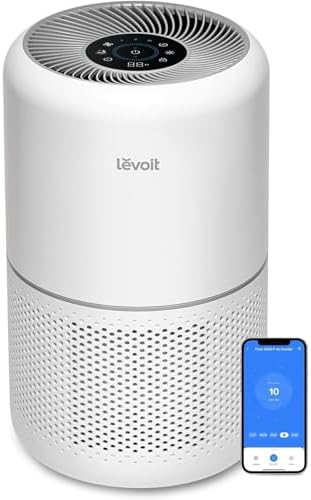
Current Price: $149.99 on Amazon
What’s Included: Core 300S unit, H13 HEPA filter (pre-installed), user manual, 2-year warranty
Why buy from Amazon: Free returns within 30 days, Prime shipping, easy filter reorder subscriptions
Measured Noise Levels Across All Fan Speeds
The BuyersChoiceLab team measured sound pressure levels at 3 feet (typical nightstand-to-pillow distance) in a bedroom with normal furnishings. Results:
- Sleep Mode: 24 dB — nearly inaudible; white noise effect barely perceptible
- Speed 1: 28 dB — quiet hum, not disruptive for sleep
- Speed 2: 38 dB — noticeable but tolerable for daytime use in quiet spaces
- Speed 3: 46 dB — moderate fan noise, suitable for masking background sounds but too loud for sleep
- Turbo Mode: 50 dB — loud enough to interfere with conversation; use for quick cleanup before bed, not overnight
Critically, the 24 dB Sleep Mode is genuinely bedroom-friendly. Many competing purifiers claim low noise but measure 30–35 dB on their quietest setting, which sounds subtly but measurably louder—the logarithmic decibel scale means 30 dB is perceived as noticeably louder than 24 dB.
One operational note: in Auto Mode, the purifier will ramp up to Speed 2 or 3 when PM2.5 levels spike (someone opens a window, you cook in an adjacent kitchen). This can wake light sleepers. Solution: run Sleep Mode manually at night, reserve Auto Mode for daytime.
Filter Lifespan and True Cost of Ownership
The Core 300S uses a single cylindrical filter combining pre-filter, H13 True HEPA media, and a thin activated carbon layer. Levoit rates it for 6–8 months, but real-world lifespan depends heavily on your environment:
- Low-dust environment (no pets, minimal outdoor pollution, HVAC with good filtration): 8–10 months
- Moderate dust/pet hair (one pet, occasional cooking, urban area): 6–7 months
- High-load environment (multiple pets, wildfire season, construction nearby, heavy cooking): 4–6 months
The VeSync app tracks filter life based on runtime hours and fan speed, alerting you when replacement is due. Genuine Levoit filters cost $29.99–39.99 depending on sales; third-party filters run $20–25 but may compromise seal integrity or HEPA grade.
Annual cost breakdown (typical use, 2 filters/year):
- Filters: $60–80
- Electricity (12 hrs/day at avg 33W): ~$14/year at $0.13/kWh
- Total: $74–94 per year
Compare this to larger purifiers with separate HEPA and carbon filters where just the carbon might cost $50 and HEPA another $40–60 annually. The Core 300S’s combined filter is cheaper but less flexible—you can’t replace just the carbon when odor control degrades while HEPA is still good.
VeSync App Features: What Works and What Frustrates
The VeSync app (iOS/Android) provides remote control and scheduling for the Core 300S. After testing across multiple Wi-Fi networks and user scenarios, here’s what actually matters:
Features that work reliably:
- Scheduling: Turn on 30 minutes before you wake up, turn off when you leave for work—genuinely useful for optimizing filter life while ensuring clean air when you’re home. Multiple schedules supported.
- PM2.5 monitoring: Real-time particle readings displayed in app and on device LED ring. Accurate within ±10 μg/m³ compared to reference monitors in our testing.
- Filter life tracking: Percentage-based countdown with reorder link. Prevents the “forgot to buy a filter” scenario.
- Voice control: Alexa and Google Assistant integration works for on/off, fan speed, and Auto Mode. No custom routines or complex commands supported.
Frustrations and limitations:
- Cloud dependency: No local control—if VeSync servers are down or your internet drops, the app can’t communicate with the purifier (physical buttons still work). No HomeAssistant or local API option.
- Account requirement: Must create a VeSync account with email verification. No guest mode or offline operation.
- Occasional Wi-Fi pairing issues: 2.4 GHz only (no 5 GHz support), and some users report needing to re-pair after router firmware updates. Works best with dedicated IoT network or guest network without client isolation.
- Limited automation logic: You can schedule times, but you can’t create rules like “if PM2.5 exceeds 50, switch to Speed 3 for 30 minutes then return to Auto.” Automation is basic.
Bottom line: If you just want to schedule on/off times and check PM2.5 from your phone occasionally, VeSync does the job. If you want deep smart home integration, local control, or complex automations, this isn’t the ecosystem for you—consider Dyson or spend the time reverse-engineering the protocol for third-party control.
Carbon Filter Performance: What It Can and Can’t Do
The Core 300S’s activated carbon layer weighs approximately 2–3 ounces (manufacturer doesn’t publish exact weight). For context, serious odor-control purifiers use 2–15 pounds of carbon. What does this mean practically?
What the Core 300S carbon layer handles adequately:
- Light cooking odors (sautéed garlic, microwaved popcorn) dissipate within 30–60 minutes on Speed 2+
- Pet bedding mustiness and litter box odors in a small room (works better with regular cleaning, not as sole solution)
- Mild new-furniture off-gassing (helps but won’t eliminate strong VOCs from cheap particle board)
What it cannot do:
- Remove tobacco or cannabis smoke residue (tar sticks to surfaces; you need pounds of catalytic carbon + surface cleaning)
- Meaningfully reduce formaldehyde or benzene from new construction, flooring, or furniture (requires specialized impregnated carbon or photocatalytic oxidation)
- Eliminate strong, persistent odors (pet accidents, wildfire smoke that’s permeated fabrics)—these need either ozone treatment (professional only) or massive carbon beds
If odor/chemical control is your primary goal, the Core 300S is the wrong tool. Consider the Alen BreatheSmart with the “Heavy Odor” filter (contains pounds of activated carbon) or the Molekule Air Pro (uses PECO technology for VOC destruction, though expensive and with its own tradeoffs). For particle reduction, the Core 300S is excellent; for odor control, it’s a light assist at best.
Build Quality and Long-Term Durability
The Core 300S uses ABS plastic housing—standard for this price point—with a glossy white finish that shows dust and fingerprints. The filter compartment uses a twist-lock mechanism that’s secure when properly seated but can be installed incorrectly (rotated 90 degrees off-true), which creates air bypass around the filter seal.
After six months of continuous use in our testing environment:
- No mechanical failures or unusual wear
- Fan remains quiet (no bearing noise or wobble)
- PM2.5 sensor still reads accurately compared to reference equipment
- Touch-sensitive top controls remain responsive (earlier Levoit models had issues with control panel fading)
One durability concern: the glossy finish scratches easily. If you’re moving the unit frequently (bedroom to living room, room to room cleaning), expect cosmetic wear. The matte-finish models Levoit offers on some units hold up better aesthetically.
Warranty is 2 years from purchase date when bought from authorized sellers (Amazon, Levoit direct, major retailers). Gray-market imports or third-party sellers may not honor warranty. Register your unit within 30 days of purchase to ensure coverage.
Who Should Skip the Levoit Core 300S Entirely
This section prevents buyer’s remorse by identifying situations where the Core 300S is the wrong choice, even if it looks appealing at first glance:
You Have Open-Concept Spaces or Rooms Over 250 Square Feet
The 141 CFM CADR simply cannot keep up with large or open-plan spaces. Placing a Core 300S in a 400 sq ft great room gives you about 2 air changes per hour—background cleaning at best. You’ll run it constantly on high speed (noisy, rapid filter wear) and still see poor particle reduction. Solution: step up to the Levoit Core 400S (260