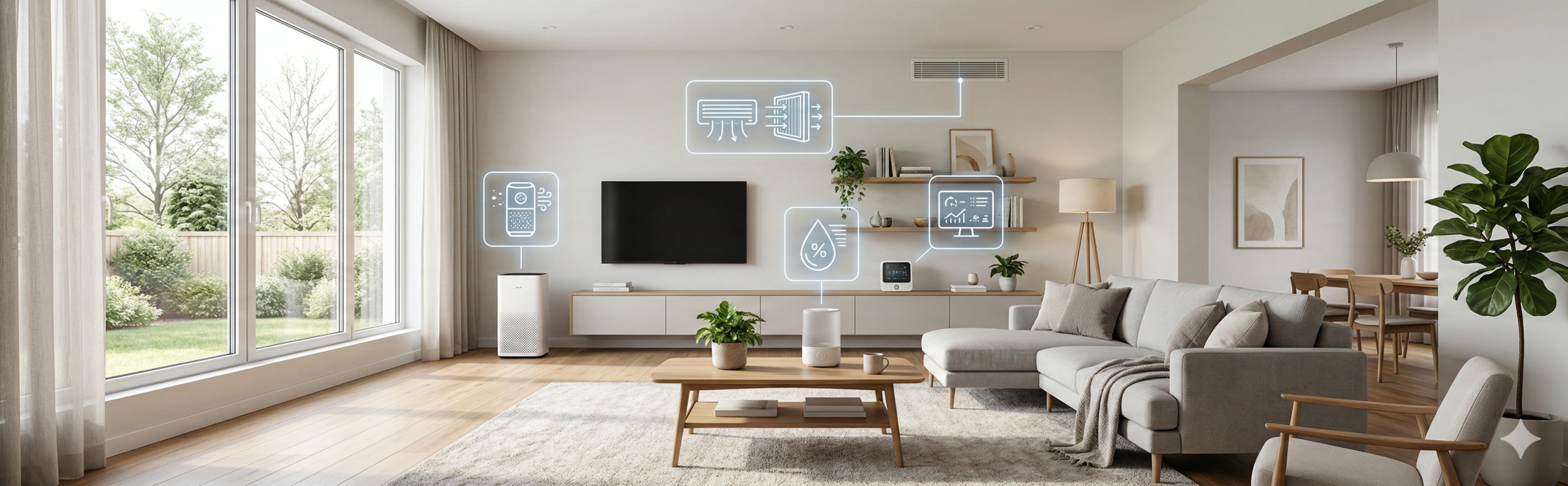
Indoor air quality (IAQ) is one of those home topics that feels obvious until you try to fix it. Maybe your allergies flare up at night. Maybe your house smells “stale” no matter how often you clean. Maybe you’ve got pets and you’re constantly dusting. Or you moved into a newer home and suddenly get headaches when the windows stay shut.
Here’s the frustrating part: “bad air” isn’t one thing. It’s usually a mix of particles (dust, dander, smoke), gases (odors and VOCs), and moisture (too dry or too damp). And each problem responds to different tools.
This guide is built to help you decide—clearly and honestly—what to do first, what to buy (and what not to buy), and how to set up a system that keeps working without turning your life into a filter-replacement hobby.
Start here
Who this is for
- You want cleaner air for allergies, pets, smoke, cooking odors, or general “stuffy” indoor air.
- You want a practical plan that prioritizes the biggest wins first (without buying everything).
- You want to choose an air purifier by room size and performance, not marketing buzzwords.
Who this is not for
- You’re dealing with active water damage, visible mold growth, sewage odors, or combustion safety issues. In those cases, stop and address the source first (often with a professional).
- You want a “one device fixes everything” answer. Real IAQ is a system.
What to buy first (in order)
- Fix moisture and sources first (leaks, damp basements, dirty litter areas, heavy fragrance use). No purifier can “out-clean” a constant pollutant source.
- Size an air purifier correctly for the room where you spend the most time (usually the bedroom). Use CADR/room volume logic, not vague “covers 1,000 sq ft” claims.
- Upgrade your HVAC filter only if your system can handle it (often MERV 13, but not always).
- Use humidity control strategically (dehumidifier for damp spaces, humidifier only when your air is genuinely too dry).
- Add an air monitor if you need feedback (to verify changes, spot patterns, or optimize ventilation).
The fastest win
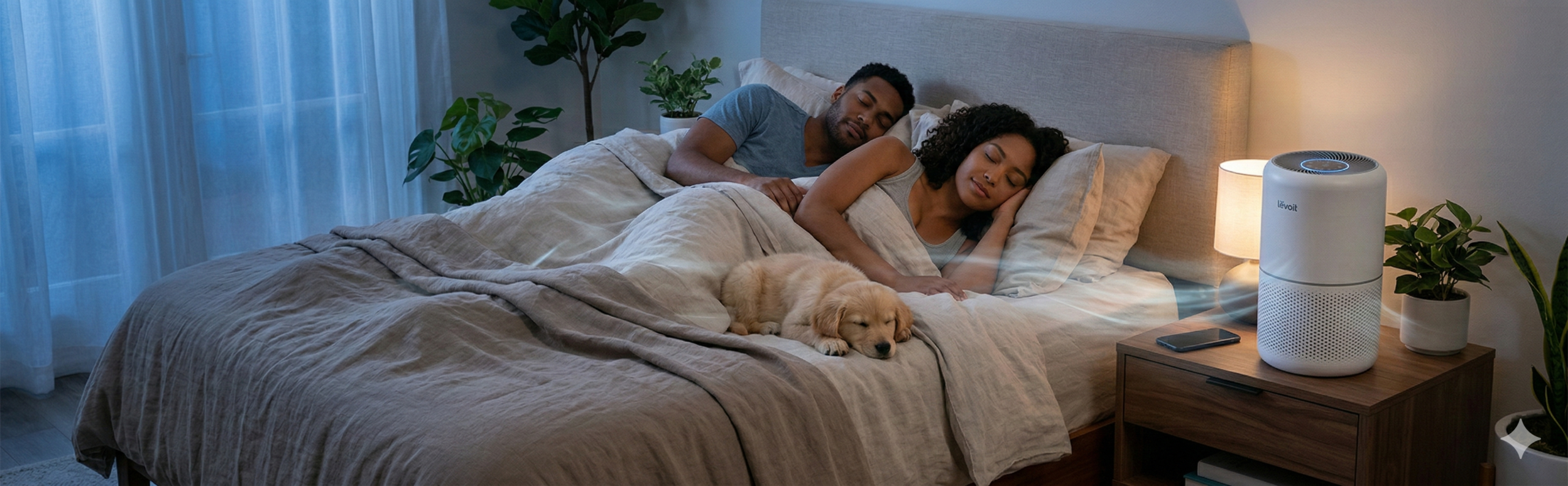
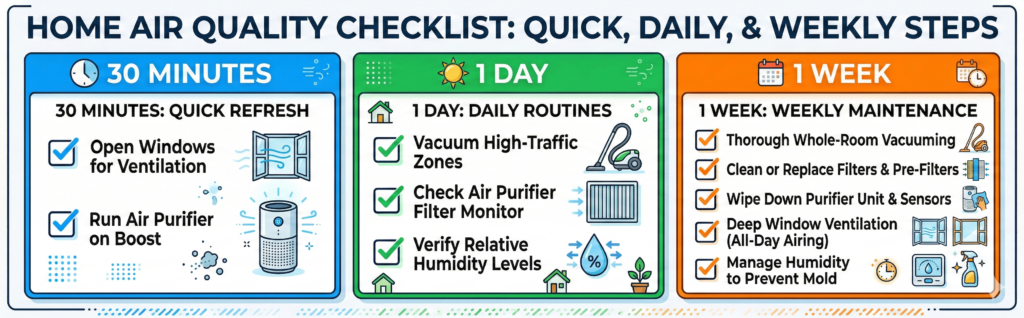
- A correctly sized air purifier running consistently in the bedroom + a sane cleaning routine usually delivers the biggest comfort improvement fastest.
Previous / Next (March 2026 daily navigation)
Previous: Editorial Policy (2026): How We Research Air Purifiers, HVAC Filters & Air Quality Monitors
Next: Air Purifier vs HVAC Filter vs Dehumidifier: What Improves Home Air Quality Most?
Quick Picks (start with these, then size correctly)
These are popular, widely discussed options in the categories we cover in this guide. The right choice depends on your room size, sensitivity (allergies vs odor vs smoke), noise tolerance, and ongoing filter costs.
Important: Before you buy, match the unit’s performance (CADR or equivalent) to your room size, and plan for filter replacement costs. If you want a straightforward sizing walkthrough, use our room size + CADR calculator guide.
🔷Levoit Core 300S (good “starter” category for many bedrooms)
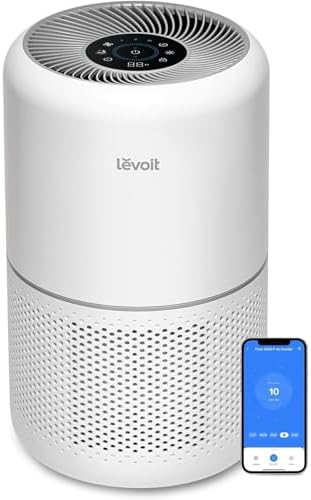
- 𝐖𝐇𝐘 𝐂𝐇𝐎𝐎𝐒𝐄 𝐀𝐇𝐀𝐌 𝐕𝐄𝐑𝐈𝐅𝐈𝐃𝐄 𝐀𝐈𝐑 𝐏𝐔𝐑𝐈𝐅𝐈𝐄𝐑𝐒: AHAM (Association of Home Appliance Manufacturers) is an ANSI-accredited organiz…
- 𝐖𝐀𝐊𝐄 𝐔𝐏 𝐑𝐄𝐅𝐑𝐄𝐒𝐇𝐄𝐃: Feeling sick after a night’s rest, the 3-in-1 filtration system helps you combat dry throats, nightly…
- 𝐀𝐂𝐂𝐄𝐒𝐒 𝐀𝐍𝐘𝐖𝐇𝐄𝐑𝐄 𝐀𝐍𝐘𝐓𝐈𝐌𝐄: Simply ask Alexa or Google Assistant to control the air purifier when your hands are full. The …
🔷Winix 5520 (often considered when odor/carbon matters)
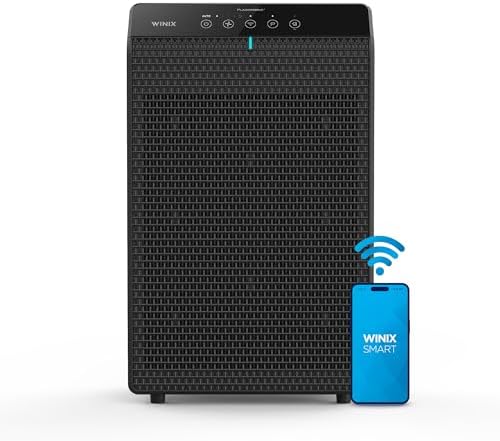
- 𝐀𝐇𝐀𝐌 𝐕𝐞𝐫𝐢𝐟𝐢𝐝𝐞 𝐚𝐭 𝟑92 𝐬𝐪 𝐟𝐭.: Also cleans rooms up to 1,882 sq ft in 1 hour (941 sq ft in 30 minutes, 627 sq ft in 20 min…
- 𝐖𝐢𝐧𝐢𝐱 𝐓𝐫𝐮𝐞 𝐇𝐄𝐏𝐀: Captures 99.99%* of airborne allergens including pollen, dust, smoke, and pet dander, as small as 0.01 …
- 𝐀𝐝𝐯𝐚𝐧𝐜𝐞𝐝 𝐎𝐝𝐨𝐫 𝐂𝐨𝐧𝐭𝐫𝐨𝐥 𝐂𝐚𝐫𝐛𝐨𝐧 𝐅𝐢𝐥𝐭𝐞𝐫: Reduces VOCs and household odors from cooking, pets, and smoke. It is designed to c…
🔷Coway Airmega 200M (commonly discussed for value and solid filtration basics)

- [Coverage] Designed to clean spaces up to 874 sq. ft. in 30 minutes or up to 1,748 sq. ft. in 60 minutes.
- [HyperCaptive Filtration System] Combination of a pre-filter, deodorization filter, and HEPA Filter reduces 99.97% of 0….
- [Auto Mode] Constantly monitoring the air quality, the fan automatically adjusts to most effectively purify your space a…
🔷Blueair 311i Max (commonly compared for higher airflow and convenience features)
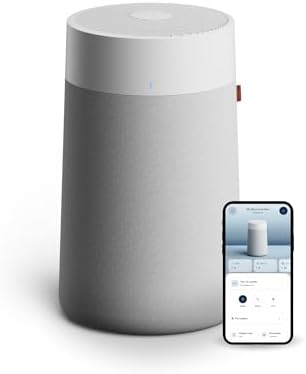
- BLUEAIR’S TOP-PERFORMING AIR PURIFIER LINE: Blue family’s new Pure Max series with our proprietary HEPASilent performanc…
- LET’S CLEAR THE AIR QUIETER: Quiet Mark certified (23-50dB); Cleans up to 1,858 sqft space in 60 min, 929sqft in 30min o…
- LET’S CLEAR THE AIR FASTER: HEPASilent dual filtration technology delivers more clean air faster and uses less noise and…
🔷If dampness/musty smell is the real issue: a dehumidifier is often the first purchase

- Compact Moisture Control – This Wi-Fi enabled dehumidifier removes up to 8 pints per day at 80°F, 60%RH (24 pints MAX at…
- Space-Saving & Ultra-Quiet – Designed for small spaces, this 38dB whisper-quiet dehumidifier keeps humidity under contro…
- Hassle-Free Drainage – Includes a 3.3ft drain hose for continuous drainage, so you never have to empty the tank manually…
Affiliate disclosure (quick and clear)
This article contains affiliate links. If you purchase through them, we may receive a commission at no additional cost to you. Our goal is to help you choose the right setup based on clear criteria—not misleading advertising. To learn about our methodology and “what we can/cannot verify,” see below and our editorial standards page.
The “bad air” problem: what you’re actually trying to fix
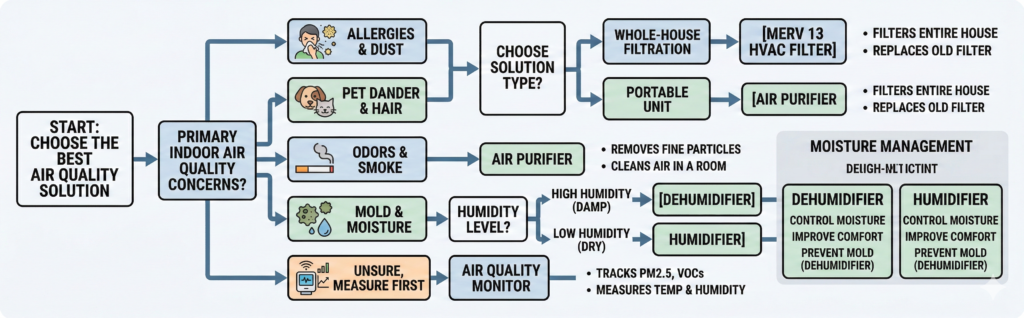
A lot of IAQ advice fails because it treats every home like the same home. In reality, indoor air problems usually fall into four buckets:
- Particles: dust, pet dander, pollen, smoke particles, fine particulate (PM2.5).
What helps: HEPA-class filtration (air purifiers), good vacuuming, better HVAC filtration (sometimes), source control (shoes off, grooming pets, cleaning routines). - Odors and gases: cooking odors, smoke smell, VOCs from cleaners, paints, new furniture, fragrances.
What helps: ventilation (fresh air), activated carbon or sorbent media (some purifiers), changing products and habits that generate the gases. - Moisture: too humid (mold risk, musty odor, dust mites thrive) or too dry (irritated nose/throat, static, discomfort).
What helps: dehumidifiers (for damp), humidifiers (for genuinely dry air), fixing leaks, controlling condensation, proper ventilation. - Stale air / ventilation issues: “it feels stuffy,” sleep feels worse, odors linger, CO2 rises in closed bedrooms.
What helps: controlled ventilation, fans in bathrooms/kitchen, opening windows strategically, sometimes monitoring CO2 trends to guide behavior.
The reason this matters: an air purifier is mostly a particle tool. It can help with some odors if it has meaningful carbon, but it does not replace ventilation and it does not fix moisture problems.
If you’re trying to solve the wrong bucket with the wrong tool, you’ll spend money and still feel the same.
The 3-step “Fix Your Air” plan (the core strategy)
This is the simplest approach that works in the widest variety of homes:
Step 1: Reduce the source (fast, cheap, unsexy, high impact)
Before you buy anything, cut the biggest pollutant sources you control:
- Stop “covering” odors with fragrance. Odor masking often adds more chemicals.
- If you have pets: wash bedding, groom regularly, vacuum with a good filter, and control the litter or pet area.
- Cooking: use your range hood (and verify it actually vents outside if possible).
- Smoke exposure: minimize infiltration (weatherstripping can help), and don’t wait to react after your house already smells smoky.
- Moisture sources: fix leaks, address damp basements, improve bathroom ventilation.
This step is about reducing what you’re asking the purifier (or filter) to clean. Lower input = better results and lower ongoing costs.
Step 2: Clean the air where you live (target the room that matters)
Most people spend ~1/3 of their day in the bedroom. If you only buy one air purifier, put it there first.
The keys:
- Pick the right size for your room
- Place it so it can actually circulate air
- Run it consistently (the “set and forget” approach usually beats occasional turbo mode)
Step 3: Stabilize the system (HVAC filter + humidity + feedback)
Once the main room is handled, you can level up:
- If your HVAC system supports it, choose a better filter (often MERV 13, but not automatically)
- Fix humidity (especially if mold/musty odor is in the picture)
- Consider a monitor if you want proof or optimization
“What we can and can’t verify” (honest expectations)
What we can do well
- Explain how to size equipment (CADR/room volume logic) so your setup is realistic.
- Compare product categories with clear trade-offs: filtration vs noise vs cost vs maintenance.
- Summarize what independent testing sources and verified directories show at a high level, and encourage you to cross-check any claims.
What we can’t do in this guide
- We are not doing hands-on lab testing in your home.
- We can’t guarantee medical outcomes for allergies or asthma. Indoor air improvements can help comfort, but health situations vary—talk to a clinician if symptoms are severe.
If you want the full methodology behind our approach, start with our Editorial Policy.
How we evaluate IAQ gear (without pretending we ran lab tests)
When we evaluate air-purifier and IAQ decisions, we use practical criteria you can verify:
- Room-fit performance
We prioritize whether the purifier can realistically circulate and filter air in your actual room volume. That usually means CADR (or equivalent airflow/filtration performance) aligned to the room. - Filtration match to your problem
- Allergies/pets/pollen: particle filtration matters most.
- Smoke and cooking odors: carbon/sorbent capacity and airflow matter more.
- Mold risk: moisture control may outrank air filtration.
- Ongoing cost and friction
A purifier that’s “great” but needs expensive filters or is too loud to run is a bad real-life choice. We consider filter replacement frequency, typical cost range, and whether the unit is likely to be used consistently. - Noise and sleep compatibility
Many people abandon purifiers because of sound or airflow sensation. We treat sleep usability as a first-class criterion, especially for bedroom-first setups. - Maintenance reality
Easy access, clear filter replacements, and a simple schedule. A complicated setup gets ignored. - Clarity and verifiability
We prefer specs and claims that can be cross-checked via verified directories and reputable reviewers over vague marketing.
Step 2 in detail: size your air purifier correctly (CADR + room volume)
If you remember one thing from this guide, make it this:
An undersized purifier is the most common “air purifier doesn’t work” story.
The sizing logic (simple, practical)
At a basic level, you want enough clean-air delivery to replace dirty air multiple times per hour. That’s often described as “air changes per hour” (ACH).
A useful way to think about it:
- Higher ACH = faster particle reduction
- The “right” ACH depends on sensitivity (allergies, smoke), room usage, and your tolerance for noise/energy
A simple calculation:
- Room volume (cubic feet) = room area (sq ft) × ceiling height (ft)
- CADR target (CFM) ≈ (Room volume × desired ACH) ÷ 60
If your ceilings are around 8 ft, here’s a practical lookup table you can use immediately.
CADR target table (8 ft ceilings)
| Room Size (sq ft) | Room Volume (cu ft) | CADR for 4 ACH (CFM) | CADR for 5 ACH (CFM) | CADR for 6 ACH (CFM) |
|---|---|---|---|---|
| 100 | 800 | 54 | 67 | 80 |
| 150 | 1,200 | 80 | 100 | 120 |
| 200 | 1,600 | 107 | 133 | 160 |
| 300 | 2,400 | 160 | 200 | 240 |
| 400 | 3,200 | 213 | 267 | 320 |
| 500 | 4,000 | 267 | 333 | 400 |
How to use this table:
- Pick your room size
- Decide your target ACH (start at 4–5; go higher if smoke/allergies are severe and you can tolerate noise)
- Match your purifier’s CADR (or a credible equivalent metric) to that target
If you want a guided version with examples and common mistakes, use our Air Purifier Room Size & CADR Calculator.
Common sizing mistakes (and how to avoid them)
Mistake 1: Buying based on “up to 1,000 sq ft” marketing
Those numbers are often based on optimistic assumptions (low ACH, ideal conditions). For bedroom air quality, you usually want stronger performance than the headline.
Mistake 2: One purifier for an entire house
Unless you have a very open floorplan and an oversized unit, a single purifier rarely keeps the entire home uniformly clean. It’s usually better to:
- Start with the bedroom
- Add a second unit for a living area if needed
Mistake 3: Ignoring placement
Even a well-sized purifier underperforms if it can’t move air:
- Give it space from walls
- Don’t bury it behind furniture
- Avoid corners that choke intake/exhaust
If you want placement guidance, our series includes a dedicated page later in the month (see the Series Index), but the core rule is simple: airflow clearance beats aesthetics.
Choosing an air purifier: what matters (and what’s mostly marketing)
The must-haves for particle problems (allergies, pets, dust, pollen)
- A robust particle filter (often HEPA-class; terminology varies)
- Enough airflow to meet your room’s CADR target
- A design you’ll actually run daily (noise, look, controls)
When carbon matters (odor, cooking, smoke)
Carbon performance is more than “has carbon.” It’s:
- Amount of carbon/sorbent media
- Airflow through that media
- How often it needs replacement
If odors are your primary complaint, prioritize:
- A purifier known for decent carbon implementation
- Ventilation habits (especially after cooking)
- Avoiding heavy fragrance sources
What to be cautious about
- Ozone claims: be skeptical of devices that “freshen” air using ionization/ozone. For most households, you want mechanical filtration and ventilation strategies.
- Tiny “desktop” purifiers for real room problems: they can be fine for very small personal spaces, but they’re often underpowered for bedrooms.
- Over-automation: smart features are nice, but airflow + filtration + proper sizing still dominate outcomes.
Product shortlist (the “realistic choices” approach)
You don’t need 20 models. You need a short list that fits your room and your problem.
Here are four commonly considered picks in this guide’s monetization set, plus where to go deeper if you want model-specific detail:
- Levoit Core 300S: see the full breakdown in our Levoit Core 300S review.
- Winix 5500-2: see pros/cons and trade-offs in our Winix 5500-2 review.
- Coway Airmega 200M: see value considerations in our Coway Airmega 200M review.
- Blueair 311i Max: if you want a dedicated deep dive later in the series, see https://buyerschoicelab.com/blueair-311i-max-review/ .
| Model (Shortlist) | Room-fit (CADR / airflow) | Filtration focus | Noise & sleep usability | Ongoing cost (filters + energy) | Best if you… | Not ideal if you… |
|---|---|---|---|---|---|---|
| Levoit Core 300S | Match to your CADR target (verify for your room) | Strong particle focus; depends on filter choice | Often chosen for bedrooms; confirm noise tolerance | Plan for regular filter replacements; energy varies by speed | Want a straightforward bedroom-first purifier | Need heavy odor control without ventilation changes |
| Winix 5520 | Match to your CADR target (verify) | Particle + meaningful odor strategy (carbon-focused designs are often considered here) | Check sleep mode behavior and fan sound profile | Factor in carbon/combined filter replacement cadence | Care about odors/cooking/smoke alongside particles | Are extremely noise-sensitive at night |
| Coway Airmega 200M | Match to your CADR target (verify) | Strong baseline particle filtration | Commonly considered for balance and simplicity | Filter costs typically manageable; verify before buying | Want value and a “set it and run it” approach | Want advanced smart features as a priority |
| Blueair 311i Max | Match to your CADR target (verify) | High airflow approach; filter design varies by model | Often compared for convenience; verify noise on needed speed | Budget for filter replacements; energy varies | Want strong circulation and modern usability | Want the lowest ongoing costs above all else |
How to read this table:
- Don’t pick a model first—pick your room-fit first.
- Then pick based on what annoys you most: particles vs odor vs noise vs maintenance cost.
- Finally, sanity-check that you’re willing to run it consistently.
- Compact Moisture Control – This Wi-Fi enabled dehumidifier removes up to 8 pints per day at 80°F, 60%RH (24 pints MAX at…
- Space-Saving & Ultra-Quiet – Designed for small spaces, this 38dB whisper-quiet dehumidifier keeps humidity under contro…
- Hassle-Free Drainage – Includes a 3.3ft drain hose for continuous drainage, so you never have to empty the tank manually…
Pros and cons (with real-world context)
Air purifier pros
- Best “single purchase” for particle comfort in a bedroom
- Provides steady improvement when run consistently
- Scales: you can add one more unit later if needed
Air purifier cons
- Doesn’t fix humidity issues or water damage
- Odor improvement depends heavily on carbon + ventilation habits
- Ongoing costs matter: filters add up, and some people stop replacing them on time
HVAC filter upgrade pros
- Whole-house baseline filtration if your system runs often
- Can reduce dust circulation through ductwork
- Convenient: you’re already replacing filters
HVAC filter upgrade cons
- Too-high restriction can stress some systems (reduced airflow, potential comfort and efficiency issues)
- Doesn’t deliver the same “bedroom-focused” effect as a purifier unless the HVAC runs frequently
- Not a substitute for humidity control
Humidity control pros
- Often the real fix for musty smell and mold risk
- Can improve comfort and reduce dust mite friendliness when humidity is too high
- A dehumidifier can “solve the root” rather than just cleaning symptoms
Humidity control cons
- Adds heat and noise
- Requires drainage planning and maintenance
- If your home is dry, dehumidification is not the answer (and can make you feel worse)
Monitors pros
- Help you see patterns (bedroom CO2 overnight, PM spikes during cooking, humidity trends)
- Useful for behavior tuning (ventilation timing, purifier speed choices)
- Adds confidence that changes are doing something
Monitors cons
- Some sensor types (especially VOC) can be tricky to interpret
- A monitor doesn’t fix the problem—it only reports it
- Can lead to overthinking if you don’t use it with a plan
Step 3: HVAC filters (MERV) — when it’s smart, and when it backfires
If your home has forced-air HVAC (central heating/cooling), the HVAC filter is part of your IAQ system. But this is where the internet oversimplifies.
The practical truth about “just use MERV 13”
MERV 13 is often recommended because it can capture smaller particles than low-MERV filters. But higher filtration can also mean higher resistance to airflow, and not every HVAC system handles that the same way.
That’s why we treat this as a conditional decision:
- If your system can handle it and you choose the right filter design, a higher-MERV filter can be a solid upgrade.
- If your system struggles with airflow, forcing a restrictive filter can create comfort problems and potentially strain equipment.
For a full, detailed walkthrough (including risks and what to look for), see our dedicated guide: MERV 13 HVAC Filters Guide.
HVAC filter “best practices” (that work in most homes)
- Replace on schedule (don’t wait until it looks “black”)
- Choose a filter size that actually fits your return grille properly
- If you upgrade MERV, pay attention to airflow and comfort changes
- Treat the HVAC filter as a baseline, and a room purifier as your targeted tool
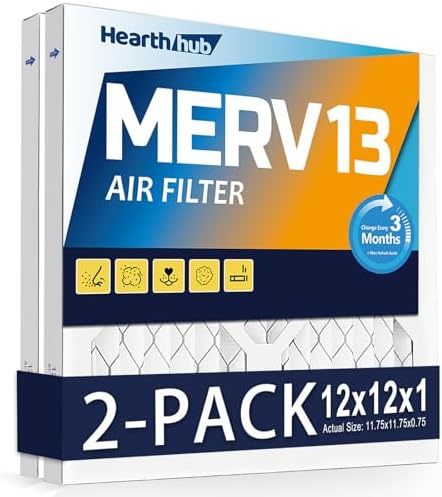
- High Efficiency Air Filter : Featuring multi-grade filtration technology MERV 13, equivalent to MPR 1900/FPR 10 , this f…
- Easy to Install and Replace: Tool-free setup. Nominal size: 12 x 12 x 1 inch, Actual 11.75×11.75×0.75. Furnace filters c…
- Advanced Structural Design: High-pleated filter media boost particle capture coverage and airflow efficiency. HVAC filte…
Humidity: the silent driver of comfort, mold risk, and “musty air”
If your home smells musty, feels clammy, or you see condensation, humidity may be the real problem—not filtration.
The goal: a stable, reasonable indoor humidity range
Most homes do best when humidity is not extreme. Too high can encourage mold and dust mites; too low can feel harsh and irritating. Instead of guessing, start by tracking humidity and then correcting the trend.
Use our reference chart here: Ideal Indoor Humidity Chart.
When a dehumidifier is the right first purchase
A dehumidifier tends to beat an air purifier when:
- You have a damp basement or ground-floor mustiness
- You see condensation (windows, cold walls)
- You smell persistent “wet” odors
- You’re fighting recurring mold/mildew in bathrooms or closets
In those cases, cleaning the air is secondary; moisture control is the root fix.
If you’re considering the Midea Cube style of dehumidifier, we cover it in the March series here: https://buyerschoicelab.com/midea-cube-50-pint-dehumidifier-review/

- 1,500 SQ. FT. DEHUMIDIFIER – Removes up to 22 pints of moisture per day with an adjustable humidity setting from 35% to …
- ULTRA QUIET OPERAION – This model has quiet operation as 47 dBA. Enjoy sleep, a good book, or your favorite show without…
- ENERGY STAR CERTIFIED- This unit is ENERGY STAR Certified and saves 31% energy when compared to traditional dehumidifier…
When you might need a humidifier (and when you probably don’t)
Humidifiers can help if your home is genuinely dry and you have comfort symptoms (dry throat, static, irritated nasal passages). But humidifying without measuring can create new problems, especially in tight homes.
Rule of thumb:
- Measure first
- Humidify carefully
- Keep it clean (humidifiers can become a source problem if neglected)
If you want a full decision guide later in the series, see: https://buyerschoicelab.com/humidifier-guide/
Do you need an air quality monitor? (Only if you’ll use it with a plan)
A monitor is helpful when:
- You want to confirm improvements (instead of relying on vibes)
- You want to catch spikes (cooking PM, smoke infiltration events)
- You suspect ventilation issues (stuffy bedrooms)
- You want to manage humidity proactively
A monitor is not helpful when:
- You’re hoping it will “solve” the problem
- You’re likely to obsess over numbers without taking actions
If you want a curated list and what each sensor type means, start here: Best Indoor Air Quality Monitors.
What to measure (practical view)
- PM2.5: helpful for smoke/cooking/particles
- Humidity: crucial for comfort and mold risk
- CO2: a decent proxy for ventilation patterns in occupied rooms
- VOC: potentially useful, but interpretation requires caution
If you want a simple monitor choice that covers multiple metrics, Airthings is one brand people consider; our series review is here: https://buyerschoicelab.com/airthings-view-plus-review/
The “best for” decision table (do this first, not everything at once)
| Your situation | First move | What to buy first (category) | Why this works | What to do next |
|---|---|---|---|---|
| Bedroom allergies, waking up stuffy | Bedroom-first filtration | Properly sized air purifier | You spend the most time there; fast particle comfort gains | Consider HVAC filter upgrade if system supports it |
| Pets + visible dust buildup | Reduce sources + filtration | Air purifier + better cleaning routine | Dander and fine dust respond well to steady filtration | Add a second purifier for living area if needed |
| Cooking odors linger | Ventilation + targeted odor strategy | Purifier with meaningful carbon (plus range hood habits) | Odors are a gas problem; airflow + carbon + ventilation helps | Consider a monitor to understand spikes |
| Musty basement or damp smell | Fix moisture first | Dehumidifier | Moisture drives mold risk and musty odor; filtration won’t fix the root | Add purifier after humidity stabilizes |
| Smoke season / wildfire events | Contain + filter + monitor patterns | Purifier sized for key rooms | Particles drive the discomfort; sealed room + purifier helps | Add second unit and track PM2.5 |
| “Stuffy” bedroom sleep | Ventilation strategy | CO2-aware habits (optionally a monitor) | Stale air often needs ventilation; purifier won’t reduce CO2 | Add purifier for particles if allergies also present |
Setup details that actually change results (not fluff)
Placement: how to make any purifier work better
- Place it in the room where you spend the most time
- Keep clear space around intake and exhaust
- Avoid placing it where the airflow is immediately blocked by beds, couches, or curtains
- If it has sensors, don’t trap it in a corner where it reads incorrectly
Run-time: why consistency beats “turbo sometimes”
Particles accumulate constantly. Running a purifier for 20 minutes on high won’t keep a room clean for the remaining 23 hours.
A better strategy:
- Run it on a comfortable medium setting most of the day
- Use higher speed when you create pollutants (vacuuming, cooking, guests, litter cleaning)
- Use a quiet mode at night if noise is an issue, but confirm it’s still moving meaningful air
Filter maintenance: the “don’t waste your purchase” rule
A purifier with a clogged or overdue filter becomes a loud fan. Put filter replacement on a calendar.
If you want a printable maintenance schedule later in the month, it’s in the March series index (end of month).
A realistic cost framework (so you don’t get surprised)
People often buy a purifier and then get annoyed by filters. The cost is manageable when you plan for it.
Annual filter cost (easy estimate)
Annual filter cost ≈ filter price × replacement frequency per year
Replacement frequency depends on:
- pets
- smoke exposure
- how often you run it
- your local dust/pollen conditions
Energy cost (simple estimate you can do in one minute)
Energy cost ≈ (watts ÷ 1000) × hours per day × 365 × your electricity rate
Even without exact numbers, this helps you compare “quiet medium all day” vs “high for short bursts.”
The point isn’t a perfect number. The point is picking a setup you’ll actually run without regretting the ongoing cost.
Room-by-room playbook (what to do where)
Bedroom (highest ROI for most people)
If you only tackle one room, do this one:
- Put the purifier near the bed but not blocked by it
- Run consistently
- Keep bedding clean; manage pet access if allergies are severe
- Consider humidity if your nose/throat feels irritated
Living room (good second purifier zone)
If you spend most evenings in a shared living space:
- A second purifier can help more than trying to “cover the whole house” with one unit
- Focus on where people gather and where pets hang out
Kitchen (odor and PM spikes)
- Use ventilation while cooking
- A purifier can reduce particle spikes, but odor reduction depends on carbon + habits
- If you’re serious about optimization, a monitor helps you see what cooking does to your air
Basement (often a moisture problem)
If you smell dampness:
- Dehumidifier first
- Address water entry, drainage, and ventilation
- Then consider filtration for residual particles
Common “IAQ myths” that waste money
Myth: “If it says HEPA, it will fix my odors”
HEPA is mainly for particles. Odors are gases, and gases need ventilation and/or sorbent media.
Myth: “My HVAC filter makes an air purifier unnecessary”
HVAC filtration helps when the system runs, but it’s not the same as a targeted purifier in a bedroom. Many homes do well with both, used intelligently.
Myth: “Bigger is always better”
An oversized unit can be great—if you’ll run it. But if it’s too loud on the speed you need, it becomes a very expensive nightstand.
Myth: “A monitor will make my air cleaner”
A monitor helps you notice patterns. Cleaning comes from actions: ventilation, filtration, humidity control, and source reduction.
Putting it all together: the simplest “buy plan” that works
If you want the lowest-effort plan that still delivers real results:
- Measure humidity (even a cheap hygrometer is useful).
- Start with a bedroom air purifier sized to your room.
- Upgrade HVAC filtration carefully (especially if you’re considering MERV 13).
- Add dehumidification if dampness is a theme, not as a random upgrade.
- Add a monitor only if you’ll act on the data.
This sequence avoids the two most common mistakes:
- buying the wrong tool for the problem
- buying too many tools before you’ve validated the first improvement
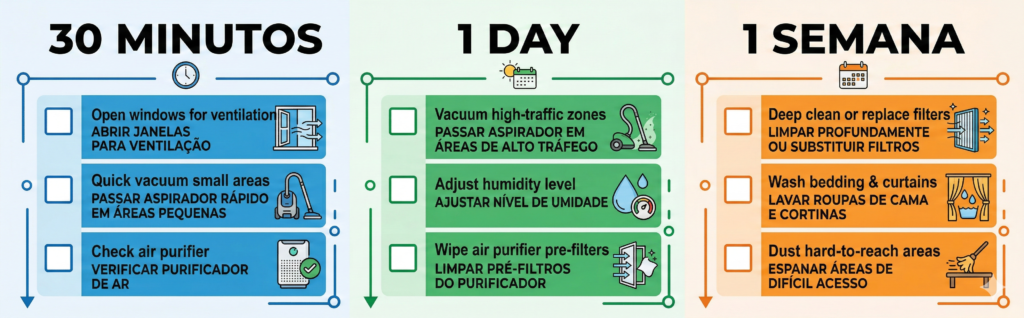
FAQ (built for real-world search questions)
1) What is the best air purifier for allergies?
The “best” one is the unit that (a) is correctly sized for your bedroom and (b) you’ll run consistently. Allergies are particle-driven for many people, so room-fit performance and filter quality usually matter more than fancy features. If you want model-specific trade-offs, start with our shortlist reviews: Levoit Core 300S, Winix 5500-2, and Coway Airmega 200M.
2) Is MERV 13 always the best HVAC filter?
Not always. MERV 13 can be a strong upgrade for particle filtration, but it may restrict airflow more than lower-MERV filters. The right answer depends on your HVAC system and comfort outcomes. Use our guide to decide safely: MERV 13 HVAC Filters Guide.
3) What indoor humidity level is best for allergies and mold prevention?
You want to avoid extremes. Too humid can support mold and dust mites; too dry can irritate airways. Use a hygrometer and aim for a stable, reasonable range. For a practical target chart and seasonal notes, see: Ideal Indoor Humidity Chart.
4) Do I need an air quality monitor if I already have an air purifier?
Only if you want feedback and you’ll use it. A monitor can help you spot spikes (cooking, smoke events) and ventilation patterns (stuffy bedrooms). If you just want cleaner air, a properly sized purifier and good habits often deliver without a monitor. If you want to shop intelligently, start here: Best Indoor Air Quality Monitors.
5) Can an air purifier fix mold problems?
An air purifier can reduce airborne particles, including some spores, but it does not remove moisture or stop mold growth. If mold risk is driven by dampness, dehumidification and fixing leaks usually outrank buying another purifier. For deeper comparisons, see the March series index and the dedicated mold content later in the month.
Conclusion: what to do now (simple, objective)
If you’re overwhelmed, do this:
- Pick your most important room (usually the bedroom).
- Size an air purifier properly (don’t guess; use CADR/room volume logic).
- Run it consistently for two weeks and see how you feel.
- If you still have “stale air” or musty smell, shift focus to ventilation and humidity control.
- Upgrade HVAC filtration thoughtfully—especially if considering MERV 13—and watch for airflow/comfort changes.
If you want a one-page shortcut:
- Use the CADR sizing guide
- Choose from the shortlist
- Put the first unit in the bedroom and run it like you mean it