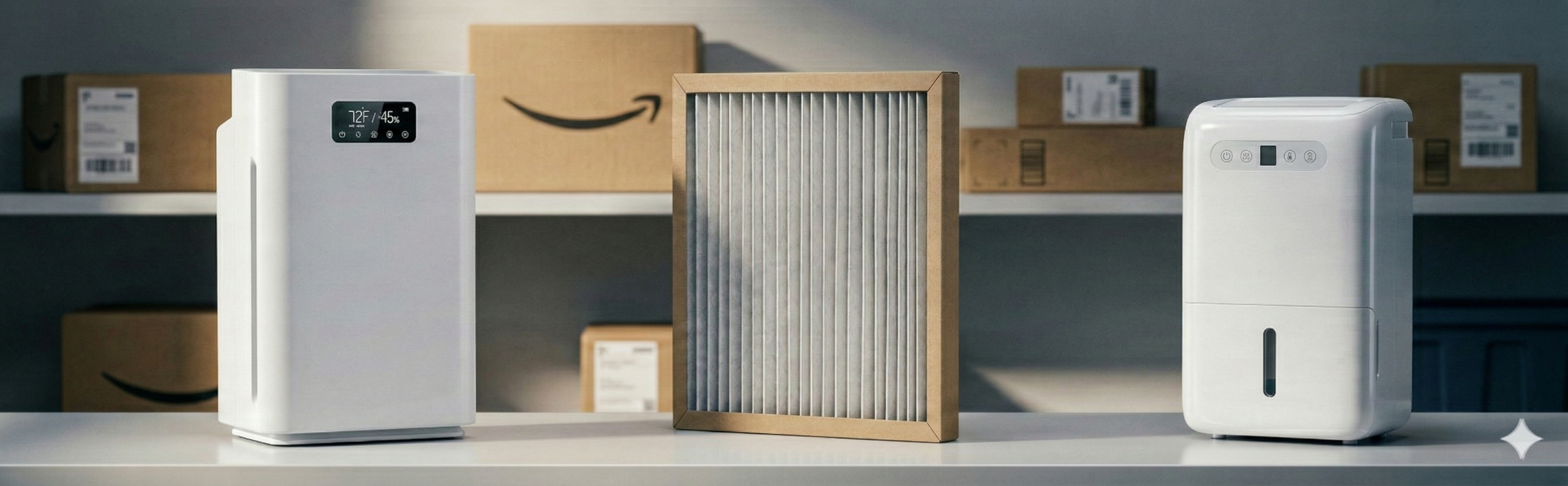
If you’re deciding between an air purifier, a better HVAC filter, or a dehumidifier, you’re not alone—these tools solve different indoor problems. The fastest way to choose is to match the device to the issue you’re actually experiencing: particles (dust, pollen, smoke), whole-home filtration (your HVAC system), or humidity (musty odors, damp basements, mold risk).
The 30-Second Answer
- Wildfire smoke, allergies, pet dander, dust in a specific room? Start with an air purifier.
- You run central air/heat and want cleaner air across the house? Upgrade your HVAC filter (often MERV 13 is a strong “sweet spot” when your system supports it).
- Musty smell, clammy rooms, basement dampness, visible condensation? You likely need a dehumidifier first.
If you’re unsure which bucket you’re in, use the decision flowchart below (and don’t worry—we’ll give real-life “best first purchase” scenarios).
Decision Flowchart: What Should You Buy First?
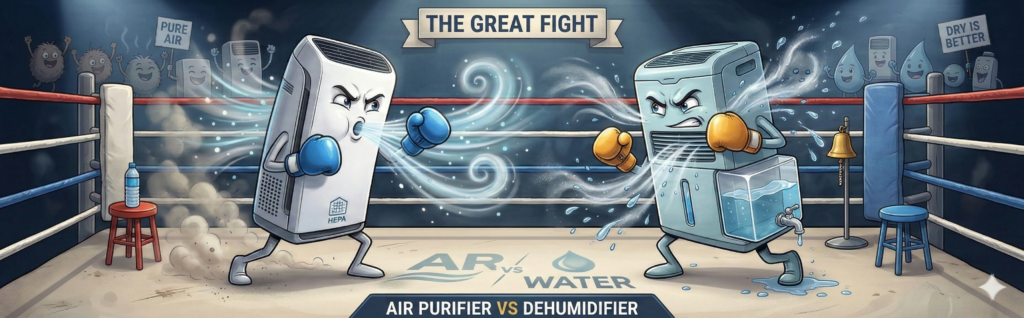
Want our shortlist and setup steps in one place? Jump to our pillar guide’s “quick picks” and full walkthrough.
See the Indoor Air Quality Guide (2026) — Quick Picks
Comparison Table: What Each Tool Fixes (and What It Doesn’t)
| Tool | Best For | Not Great For | Ongoing Maintenance |
|---|---|---|---|
| Air Purifier | Particles in a specific room: pollen, pet dander, dust, smoke, haze. | Fixing humidity or dampness; solving source problems like leaks, mold growth, or outdoor infiltration. | Replace filters (HEPA/combined) on a schedule; keep intake unobstructed; right-size the unit to the room. |
| HVAC Filter Upgrade | Cleaner air across many rooms when your HVAC is running. Great “baseline” improvement for most homes with central air/heat. | Capturing pollutants when the HVAC is off; tackling humidity; filtering air in rooms far from returns. | Replace the filter more frequently at higher filtration levels; confirm your system can handle higher resistance. |
| Dehumidifier | Humidity control: musty smell, damp basements, condensation, comfort, mold-risk environments. | Removing smoke/pollen particles by itself (it won’t); fixing the source of water intrusion. | Empty or drain continuously; clean the bucket/tank; clean filters/coils as recommended; place for good airflow. |
Now let’s translate this into real buying decisions—based on your situation.
Scenario Guide: The Best First Purchase (Practical, Not Salesy)
1) Allergies (pollen, dust) in a bedroom
Start with a room-sized air purifier. Allergies are often driven by airborne particles, and purifiers are designed to cycle room air repeatedly. Use CADR/room-size guidance (more on CADR below) and place it where it can “breathe.”
Also consider upgrading your central HVAC filter as a baseline if you have central air. (Here’s our guide: MERV 13 HVAC Filters Guide.)
2) Pets (dander + odors) in a living area
For dander, a purifier helps most. For odor, you’ll want a purifier with meaningful activated carbon (or a separate odor strategy), plus basics like cleaning textiles and improving ventilation.
If you’re deciding between “purifier vs HVAC filter,” it usually comes down to whether the issue is concentrated in one room (purifier) or you want a house-wide baseline (HVAC filter).
3) Basement mustiness, visible condensation, or recurring dampness
Start with a dehumidifier. Dampness is a mold-risk and comfort issue; a purifier can’t “dry” the air. If the smell persists after humidity control, then consider adding a purifier for particles and residual odors.
If you want a deep dive on a popular option, see: Midea Cube Dehumidifier Review. For efficiency context, Energy Star explains dehumidifier efficiency and certified products: Energy Star — Dehumidifiers.
4) Wildfire smoke (or heavy outdoor smoke events)
Start with an air purifier sized to the room you spend the most time in (often the bedroom + main living space). Smoke events are particle-heavy; focus on filtration and air changes. An HVAC filter upgrade can help when the system runs, but a purifier is typically the “fastest impact” in a single room.
If you’re unsure how to size correctly, use our helper: Air Purifier Size + CADR Calculator.
How to Choose an Air Purifier (Without Guessing)
The most misunderstood spec is CADR (Clean Air Delivery Rate). CADR is commonly used to communicate how quickly a purifier can reduce particle levels in a room (it’s a performance-related number tied to airflow and filtration for particles). The Association of Home Appliance Manufacturers (AHAM) maintains a directory where many models list CADR and recommended room size: AHAM Verifide — Directory of Air Cleaners.
Rule of thumb: buy for the room you’re in most, and size it to that room (not the whole house). If your symptoms are strongest at night, prioritize the bedroom.
When an HVAC Filter Upgrade Is the Smartest First Step
If you have central heating/cooling and it runs regularly, your HVAC filter can be a powerful “baseline” improvement across multiple rooms. A common choice people explore is MERV 13—strong filtration for many particle types—if your system supports it. Higher filtration can increase airflow resistance, so it’s worth confirming compatibility and replacing filters on time.
For a practical breakdown (including compatibility and replacement cadence), see: MERV 13 HVAC Filters Guide.
When a Dehumidifier Beats Everything Else
Dehumidifiers don’t “clean” air in the particle sense—they manage moisture. If your home feels clammy, smells musty, or shows condensation on windows/walls, humidity control is often the most meaningful improvement you can make.
FAQ
Should I buy an air purifier or upgrade my HVAC filter first?
If your problem is concentrated in one room (bedroom allergies, smoke in the living room), start with an air purifier sized to that room. If you want a baseline improvement across multiple rooms and your HVAC runs regularly, an HVAC filter upgrade is often the best “first step.”
Does a dehumidifier improve air quality for allergies?
A dehumidifier helps when humidity is the driver—like mustiness, dampness, and mold risk. It doesn’t remove pollen or smoke particles the way filtration does. If allergies are your main complaint, an air purifier and/or HVAC filtration usually targets the root problem more directly.
What is CADR and why does it matter?
CADR is a commonly used metric tied to how effectively a purifier can deliver clean air (for particles) to a room. It can help you avoid under-sizing. AHAM’s directory is a helpful place to see CADR and room-size guidance for many models: AHAM Verifide Directory.
Will a higher MERV HVAC filter always be better?
Not always. Higher MERV can mean higher resistance, which may reduce airflow in systems that aren’t designed for it. If you’re considering MERV 13, make sure it’s compatible with your system and replace it consistently. Our practical guide is here: MERV 13 HVAC Filters Guide.
Can I “stack” these tools?
Yes—and it’s often the best approach. Think in layers: HVAC filter for baseline, purifier for the rooms that matter most, and dehumidifier where moisture is the issue.
Bottom Line: Match the Tool to the Problem
If you want the highest chance of making a noticeable difference quickly, start with the most obvious symptom: particles (purifier), whole-home baseline (HVAC filter), or dampness (dehumidifier).
If you want a complete, research-guided setup plan (plus our quick picks), use the pillar guide:
Indoor Air Quality at Home (2026) — Purifiers, Filters, Humidity & Monitors
Sources referenced: Energy Star (dehumidifiers) and AHAM Verifide (CADR + air cleaner directory).