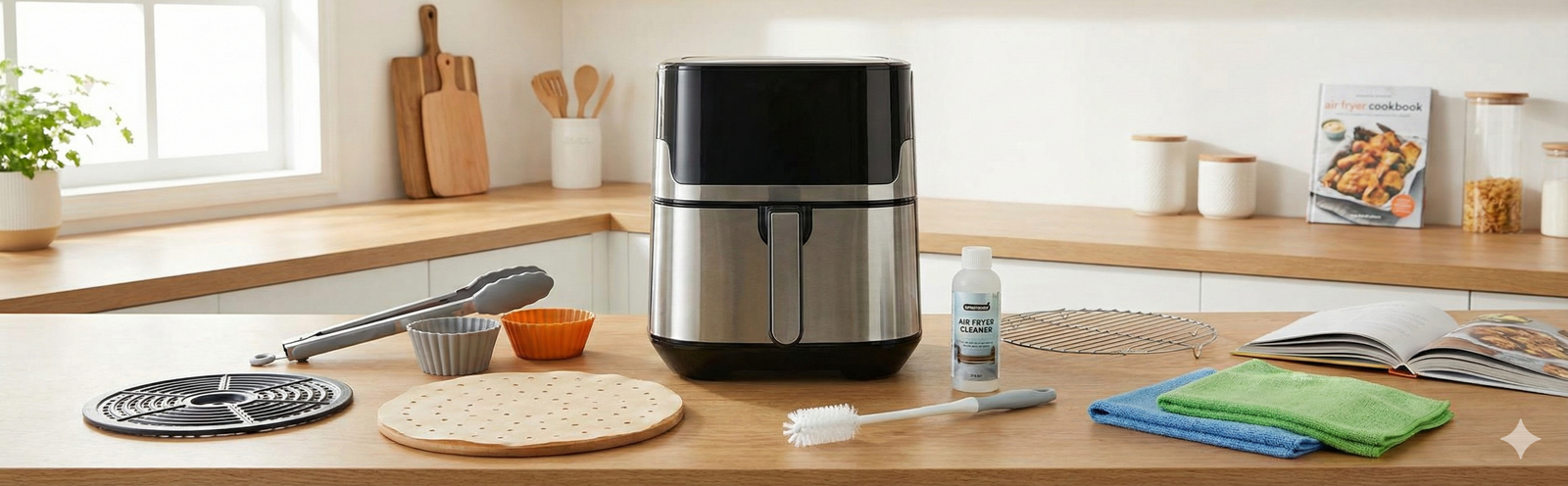

If you’re cooking for a family, the biggest challenge usually isn’t the recipe—it’s the clock. Between school runs, work, and the daily “what’s for dinner?” question, it’s easy to buy kitchen tools that seem helpful… and end up living in a drawer because they’re annoying to clean, don’t work as expected, or take up too much space.
Choosing the right time-saving kitchen tools is tricky because “faster” can mean different things:
- Faster prep (less chopping, less measuring)
- Faster cooking (more consistent results, fewer do-overs)
- Faster cleanup (less mess, fewer parts)
This guide is 100% educational: it will help you choose tools that genuinely save time for busy families—without wasting money on clutter.
Buy the best products already selected here in this post.
Key Criteria for Choosing Time-Saving Kitchen Tools
1) Materials (what matters for real-life family cooking)
Look for materials that survive daily use and repeated washing:
- Stainless steel (blades, grating surfaces, probes): usually more durable, resists rust, handles pressure better.
- Food-safe plastics (BPA-free): fine for bodies/containers, but avoid thin, flimsy plastic that flexes while cutting or pressing.
- Silicone (spatulas, jar openers): great for heat resistance and grip—check temperature ratings when relevant.
- Glass bowls/containers: heavier but less likely to stain or hold odors.
Family tip: If it touches heat, pressure, or sharp edges, prioritize sturdier materials.
2) Size and capacity (match your household reality)
A tool that’s “too small” forces multiple batches. A tool that’s “too big” becomes a storage problem.
- For families, prioritize capacity that matches your usual batch size (e.g., chopping onions for multiple meals, making soup for leftovers).
- Consider counter space + cabinet space. If it’s hard to store, it gets used less.
Rule of thumb: The “right” size is the one you’ll realistically grab on a weeknight.
3) Durability (what to check before buying)
Time-saving tools are only time-saving if they don’t break after a few weeks.
What to look for:
- Fewer weak connection points (hinges, locks, plastic gears)
- Clear warranty/support information
- Replacement parts availability (common with some tool types)
How to verify quickly: read recent reviews and search for patterns like “broke,” “cracked,” “stopped working,” “blade dulled.”
4) Functionality (does it actually remove a step?)
The best time savers remove friction from tasks you do often:
- Speed up repetitive prep (dicing, slicing, mincing)
- Reduce mistakes (overcooking/undercooking)
- Minimize extra bowls/transfers (blending in-pot, measuring by weight)
Ask:
- “Does this tool eliminate a step I do multiple times a week?”
- “Will it reduce redo’s or cleanup?”
5) Ease of use and cleaning (the most underrated criterion)
This is where most “cool gadgets” fail in real kitchens.
Look for:
- Dishwasher-safe parts (or truly rinse-clean surfaces)
- Minimal parts and no tiny crevices that trap food
- Comfortable grip (especially if you prep a lot)
- Easy disassembly/reassembly
Busy-family truth: If it’s a pain to clean, it’s not a time saver.
6) Real-world feedback (how to read reviews like a pro)
Amazon reviews (plus social posts and recommendation threads) are useful when you filter intelligently:
- Sort by Most Recent (quality can change over time)
- Read 3-star reviews (often the most balanced)
- Search within reviews for keywords:
- “hard to clean,” “dull,” “broke,” “bulky,” “leaks,” “rust,” “battery”
- Check the Q&A section (real usage details show up there)
- Watch for “review patterns,” not one-off complaints
If you also check outside Amazon:
- Look for consistent feedback in cooking communities, forums, or social posts (especially about durability and cleaning).
Common Mistakes Busy Families Make (and How to Avoid Them)
Mistake 1: Buying a “time saver” that adds cleaning time
What happens: Multi-part tools look efficient but take forever to wash.
Avoid it: Choose tools with fewer parts, dishwasher-safe designs, and smooth surfaces.
Mistake 2: Choosing the smallest/cheapest option for a high-stress task
What happens: Small capacity = multiple batches; cheap build = breakage.
Avoid it: For daily-use tools, prioritize sturdiness and enough capacity for your typical meal size.
Mistake 3: Ignoring storage and reaching convenience
What happens: The tool doesn’t fit your space, so you don’t use it.
Avoid it: Measure your drawer/cabinet space and choose compact designs for daily tools.
Mistake 4: Getting tools that duplicate each other
What happens: You end up with three tools that “kind of” do the same thing.
Avoid it: Pick based on your real bottleneck: prep speed, cooking accuracy, or cleanup.
Mistake 5: Falling for “one tool does everything”
What happens: Multi-function tools can be mediocre at every job and harder to clean.
Avoid it: Prefer a few highly-used basics that do one job extremely well.
When It’s Worth Paying More
Not every kitchen tool needs to be premium. But for busy families, it’s worth paying more when the tool impacts safety, consistency, or daily repetition.
Pay more when:
- Accuracy matters (tools that prevent undercooked food or ruined meals)
- Motorized tools are involved (cheap motors fail faster)
- The tool handles high pressure or sharp blades (durability and safer design matter)
- You’ll use it multiple times per week
Go budget-friendly when:
- The tool is simple with low failure risk (basic peelers, simple measuring tools)
- Replacement is easy and not disruptive
Practical test: If a failure would ruin dinner on a rushed night, don’t buy the lowest-quality version.
Next Step: See the Specific Picks (Without Wasting Hours Searching)
Now that you know how to choose tools that truly save time, the fastest way to finish your decision is to see a curated list of practical, everyday picks.
Go to the pillar post for specific recommendations, typical price ranges, and the best “actually used” gadgets:
Best Kitchen Gadgets on Amazon for Everyday Cooking (That You’ll Actually Use)
https://buyerschoicelab.com/best-kitchen-gadgets-amazon/