Small-home closets rarely fail because you “need more stuff.” They fail because the wrong organizer adds one more layer between you and the things you use every day. A shelf that blocks sweaters you reach for often. A hanging unit that sags after a busy week. A bin that looks tidy until you need something from the bottom. In other words, the problem is usually not organization itself. It is buying a system that looks smart in a photo but creates friction in real life.
That is why the best closet organizers for small homes are almost never the flashiest ones. The organizers that actually stay useful tend to do a few simple things well: they fit the closet you already have, keep everyday items visible, reduce stacking and digging, and make it easier to put things back where they belong. If an organizer saves time on a normal Tuesday morning, it has a chance of lasting. If it only looks good right after a weekend reset, it will probably become closet clutter.
This guide is built around that real-life filter. Instead of treating every organizer as equally useful, we are focusing on what tends to work in apartments, condos, older homes with shallow reach-in closets, shared bedroom closets, and multi-use storage spaces. If you are building a broader room-by-room system, you can also use our whole-home storage and organization guide and our small-space storage planning guide alongside this article.
TL;DR
The closet organizers that work best in small homes are the ones that reduce daily friction, not the ones that promise a total transformation. In most cases, that means vertical organizers, shelf dividers, drawer bins, slim shoe storage, and simple labeled categories. Start by measuring your real usable space, then match the organizer to the problem you are trying to solve: visibility, folding collapse, shoe overflow, accessories, or shared storage. Skip anything bulky, overly deep, hard to reset, or dependent on “perfect behavior” to keep working.
Why Most Closet Organizers Fail in Real Life
Most disappointing organizers fail for one of five reasons, and all of them matter more in a small home because there is less room to hide a bad decision.
1) They solve the wrong problem
A lot of people buy a “closet organizer” before they identify the actual pain point. But closet frustration is not one single issue. Sometimes the real problem is folded clothes collapsing. Sometimes it is nowhere to keep shoes off the floor. Sometimes it is that accessories disappear because they are mixed with everything else. Sometimes it is simply that the closet has no visual zones. If you buy a hanging shelf when the real problem is shoe sprawl, you did not organize anything. You just added another layer inside the closet.
2) They take up more space than they return
In a small closet, every inch has to earn its keep. Some organizers look space-saving but are actually space-consuming because of thick frames, awkward corners, or oversized compartments. The common trap is choosing a product that technically fits the closet width but wastes useful depth or blocks access to nearby items. If the organizer makes it harder to reach what you wear most, it is not really saving space.
3) They depend on constant maintenance
The organizer that works on day one but becomes annoying by week two is the organizer that leaves. Small-home organization has to survive laundry day, busy mornings, last-minute outfit changes, and the tendency to toss something “just for now.” If a system only looks good when every item is folded perfectly and returned precisely, it is too fragile for normal use. Good organizers are forgiving. They still work when real life is messy.
4) They hide too much
Hidden storage can be useful, but in small closets it often becomes delayed-decision storage. In plain English: you forget what is inside, stop using it well, and start re-buying or re-searching for things. Open or semi-open organizers tend to work better for everyday categories because they lower friction. You can see where items belong, spot overflow faster, and return things without opening three separate containers first.
5) They ignore the limits of small-home living
Shared closets, rental restrictions, low shelf counts, shallow depth, and mixed-use storage all change what “good organization” looks like. A closet in a small home often stores more than clothing alone. It may hold extra linens, bags, shoes, seasonal items, cleaning supplies, or backup toiletries. That means a useful organizer has to fit the real lifestyle of the home, not an idealized single-purpose closet with empty breathing room all around it.
The big takeaway: the best organizer is not the one with the most compartments. It is the one that makes the next use easier. That is the standard small-home storage has to meet.
What People Usually Mean When They Search for Closet Organizers for Small Homes
When people search for closet organizers for small homes, they usually are not looking for abstract design inspiration. They want answers to practical questions:
- What can I add without remodeling the closet?
- What works in a rental?
- How do I stop piles from collapsing?
- How do I fit shoes, accessories, and folded clothes in one reach-in closet?
- What helps a shared closet feel less chaotic?
- What organizer types are actually worth buying?
That is an important distinction, because it changes how you should evaluate options. The goal is not to create a magazine-ready closet. The goal is to create a closet that is easier to use at 7:15 a.m., easier to reset after laundry, and easier to share without constant negotiation. If you want a broader strategy beyond the closet itself, the best companion read is our small-space storage guide, which helps you make better decisions across the rest of a compact home too.
The FITS Framework: A Better Way to Choose Closet Organizers
To keep this article practical, here is a simple framework you can use before buying any closet organizer. We call it the FITS Framework, because the organizer has to do more than fit physically. It has to fit the way the closet is actually used.
F = Fit the real dimensions, not the imagined ones
This is the first test, and it rules out more products than most people expect. Measure the usable width, hanging height, shelf depth, floor depth, and door swing or reach path. Then think about soft limits too: coat bulk, hanger width, folded item height, and how much room you need for your hand to reach in comfortably. An organizer that technically fits but creates tight, annoying access is a bad fit.
The easiest small-home mistake is measuring only the main closet opening and forgetting internal constraints. Maybe the shelf is not level. Maybe the hanging clothes flare out at the bottom. Maybe the closet floor narrows because of trim or a door track. Maybe the rod sits lower than expected. The more compact the closet, the less forgiveness you have for buying “close enough.”
I = Immediate access beats theoretical capacity
People often choose organizers by asking, “How much can this hold?” A better question is, “How easily can I use what it holds?” A closet that stores more but takes longer to work with will feel worse, not better. That is why low-friction organizers usually outperform high-capacity ones in small homes. You want your daily items visible, reachable, and simple to return.
Immediate access matters most for categories used several times a week: socks, underwear, gym clothes, frequently worn tops, everyday shoes, belts, bags, and workwear. These categories deserve the best real estate and the simplest storage tools. Formalwear, off-season items, or backup bedding can tolerate slower storage solutions because they are not touched every day.
T = Tolerance for real habits is more important than perfection
A good organizer should still work when you are tired, late, or halfway through putting laundry away. If it demands perfectly folded stacks, exact item counts, or delicate balancing, it will break down fast. Organizers for small homes should have some tolerance built in. They should let you put items back imperfectly and still keep the category readable and contained.
This is one reason simple dividers and bins often outperform more complicated systems. They create boundaries without demanding precision. You do not need a perfect routine to keep them useful. That is a huge advantage in real homes.
S = Sightlines matter more than most people think
In a small closet, visual clarity is not just about looking neat. It changes how fast you make decisions. When you can see categories clearly, you spend less time searching, digging, and second-guessing. That reduces small daily stress in a way that people notice quickly. Even if your closet is not “beautiful,” it feels better when it is readable.
Readable closets usually have obvious zones: hanging clothes here, folded sweaters there, shoes low, accessories grouped, overflow items separated. You do not need a designer system to achieve this. You need a consistent structure that lets your eyes understand the space at a glance.
S = Seconds to reset should stay low
This may be the most useful test of all. Ask yourself: after using this organizer for a week, how many seconds does it take to reset each category? If the answer is “too many,” the system will decay. Small-home storage improves when return paths are short and obvious. A shoe should go back in one motion. A folded shirt should land in one category without reshuffling everything around it. A belt or bag should have a home you can use without thinking.
If you remember only one part of this guide, remember this: the organizer that wins is the one that keeps reset time low.
Measure Before You Buy: The Small-Closet Checklist That Prevents Regret
Before adding anything to the closet, take a few quick measurements and notes. This step feels boring, but it prevents most bad purchases.
Measure these six things
- Usable width: not just wall-to-wall width, but the width available once clothes and trim are considered.
- Hanging drop: from rod to floor or rod to shelf, depending on what is below it.
- Shelf depth: critical for folded clothes, bins, and under-shelf accessories.
- Floor depth: especially important for shoes, baskets, and narrow racks.
- Vertical leftovers: the often-wasted space above hanging clothes or under an existing shelf.
- Door or reach interference: how the closet door opens, and whether your hands can still reach comfortably past the organizer.
Take one habit inventory too
Measurements alone are not enough. Make a short list of what the closet stores and how often each category gets used. Most people benefit from sorting categories into three buckets:
- Daily or near-daily: work clothes, basics, underwear, often-worn shoes, bags.
- Weekly: gym gear, denim, seasonal layers, accessories.
- Occasional: formalwear, off-season items, extra linens, backups.
That habit inventory helps you decide what deserves prime access and what can move higher, deeper, or lower. It also prevents a common mistake: giving occasional items the best spots and forcing daily items into the most frustrating zones.
A simple rule that works well:
Store your highest-frequency items between shoulder height and knee height whenever possible. Small-home closets feel easier immediately when the most-used categories stop living in the hardest-to-reach places.
Closet Organizer Types Compared
No single organizer type works for every closet. What matters is matching the organizer to the job. The table below is a practical overview of what tends to work best, where it struggles, and who it suits.
| Organizer type | Best for | Works well when | Usually fails when |
|---|---|---|---|
| Hanging shelf organizer | Sweaters, tees, kids’ clothes, handbags | You have unused vertical space and light-to-medium weight categories | It gets overloaded or used for bulky heavy items |
| Shelf dividers | Folded stacks that collapse | You already have shelves but poor category boundaries | Shelves are too shallow or stacks are too tall |
| Drawer bins or inserts | Underwear, socks, accessories, small folded items | You want fast visual sorting and repeatable categories | Bins are too deep, too many, or mismatched to drawer size |
| Slim shoe rack or shoe shelf | Shoes crowding the closet floor | You need structure without taking over walking space | The rack is deeper than the closet can handle |
| Over-door organizer | Accessories, small items, lightweight extras | Door clearance is good and categories are light | The door rubs, swings poorly, or holds heavy items |
| Labeled bins on upper shelf | Off-season or occasional-use items | You need cleaner category separation above eye level | You put daily items into them and forget what is inside |
The easiest way to use this table is to pick the one frustration you feel most often. Then choose the organizer type that solves that exact issue. Do not try to solve the whole closet with one product category. Small spaces improve fastest when you fix the biggest bottleneck first.
Which Closet Organizer Types Are Usually Worth It
Hanging shelf organizers
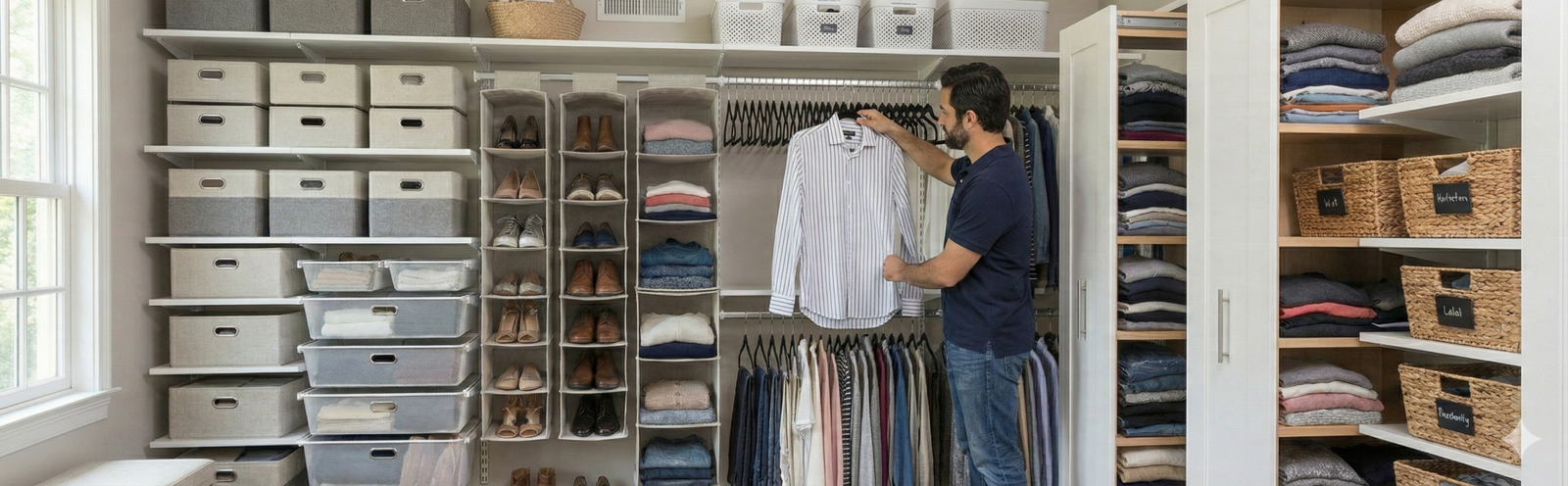
These are often one of the best first upgrades for a small closet because they turn unused vertical air into real storage without permanent installation. They are especially useful for folded categories that tend to drift: T-shirts, leggings, knitwear, small bags, kids’ outfits, and lightweight accessories. They also work well for renters because they typically do not require drilling or closet modification.
Where people go wrong is treating them like tiny shelves that can carry everything. They work best when each cubby has a clear category and the items are relatively light. Heavy denim stacks, dense sweatshirts, or mixed bulky layers can cause sagging and make the whole organizer harder to use. If you choose this type, use it for categories that benefit from separation and quick visibility rather than maximum weight.
Shelf dividers
Shelf dividers are underrated because they do not seem dramatic, but they solve one of the most annoying closet problems: the slow collapse of folded stacks. In small homes, where one shelf may hold multiple categories, dividers create clear boundaries without adding much bulk. They are especially useful for sweaters, jeans, towels in mixed-use closets, or kids’ clothing categories that would otherwise blend into one unstable pile.
The biggest advantage is that they preserve access. You are not putting items inside another box. You are simply telling each category where it stops. That makes shelf dividers a very strong option when the shelf itself is fine but the structure on top of it is not.
Drawer bins and inserts
If your closet setup includes drawers, this is one of the highest-return organization upgrades you can make. Drawer bins work because they turn “mixed small items” into repeatable categories. Socks stop spreading. Undergarments stop sliding together. Belts, ties, watch straps, and small accessories become visible instead of layered. In a small home, visibility is half the battle.
They also reduce re-folding and digging. When each item class has a zone, you do not have to disrupt the entire drawer to find one thing. The key is not to overdivide. Too many tiny compartments can become irritating. In most cases, fewer, broader zones work better than hyper-specific ones.
Slim shoe storage
Shoes are one of the most common reasons small closets feel crowded. They expand unpredictably, spread into shared floor space, and tend to block access to everything around them. Slim shoe storage helps not because shoes suddenly take up no room, but because it stops them from spilling in all directions. That alone makes a closet feel more manageable.
The best shoe setup in a compact closet is usually the one that uses floor depth wisely without turning the whole lower closet into a shoe monument. Keep everyday pairs easiest to reach. Move infrequent or seasonal pairs higher, farther back, or into clearly labeled storage elsewhere.
Over-door organizers
These can be very effective in small homes when the categories are right: scarves, belts, smaller accessories, lightweight beauty items, or compact daily extras. They are often best when the closet interior is already full but the door can still do some work. They also suit renters because they can add storage without altering walls or shelving.
That said, they are not automatic winners. They fail when overloaded, when pockets are too deep to see into, or when the door clearance becomes annoying. If you are considering one, make sure the benefit outweighs the extra motion and the visual clutter it can create.
Upper-shelf bins for low-frequency items
Upper shelves often become the most chaotic zone in a small closet because they collect categories without structure. Bins can help a lot here, but only for the right items. Use them for low-frequency or seasonal storage: spare linens, travel accessories, cold-weather add-ons, keepsakes you genuinely want to keep, or category-specific overflow.
Do not put daily-use items in hard-to-read bins on the upper shelf unless you enjoy repeated frustration. Upper-shelf bins are best when they clean up visual noise and separate occasional categories, not when they hide things you need constantly.
Helpful next step:
If your closet is only one part of a larger space problem, pair this article with our storage and organization guide for the whole home. If your main issue is deciding where storage should live in a compact layout, the better companion piece is storage solutions for small spaces.
Who Should Skip Buying Closet Organizers Right Now
Not everyone should buy organizers immediately. Sometimes the smartest move is to wait, edit down what the closet holds, or fix a deeper storage problem first.
Skip for now if your closet is really a decluttering problem
If the closet is packed with clothes you do not wear, duplicate categories, or “maybe someday” items, new organizers may simply compress the problem. They can make a crowded closet look more structured while leaving the real issue untouched. In that situation, edit first. Organize second.
Skip for now if you are about to move or remodel
If the closet itself may change soon, avoid buying a system around temporary dimensions unless the need is urgent. Portable, low-commitment options are fine, but it rarely makes sense to design a highly specific setup for a closet you may leave in a few months.
Skip for now if you have not measured anything
This is the most common preventable mistake. It is better to wait one more day, measure properly, and buy once than to keep cycling through organizers that almost work.
Skip for now if your real issue is lack of storage somewhere else
Sometimes the closet is overloaded because the rest of the home has no system. Maybe linens belong in a hallway cabinet, entryway gear belongs by the door, or laundry items need their own zone. If that sounds familiar, do not force the closet to absorb everything. Use a more complete storage plan across the home instead of asking one closet to act like an entire utility room.
Common Small-Closet Mistakes That Make Organizers Less Useful
Buying for aesthetics before function
Matching bins, neat labels, and a unified look can absolutely help. But function should come first. A visually clean system that is hard to use will decay fast. Build around access, frequency, and category clarity first. Then improve the look.
Using one organizer to solve every problem
A single organizer type rarely handles hanging clothes, folded items, accessories, and shoes equally well. That is why closets improve more when they become a combination of simple zones rather than a one-product solution.
Storing by category size instead of use frequency
People often put the biggest categories in the easiest spots and push frequently used smaller items into awkward corners. But small daily items can create more friction than occasional bulky ones. Put the categories you touch most where they are easiest to access.
Overfilling every compartment
An organizer that is packed to the limit often becomes harder to maintain than no organizer at all. Leaving a little breathing room is not wasted space. It is functional space. It gives the system tolerance so it can handle laundry day, seasonal shifts, and small changes in volume.
Mixing daily-use and occasional-use items together
This is one of the biggest hidden sources of closet frustration. When event wear sits next to basics, or travel accessories mix with everyday ones, your brain has to re-sort the closet every time you look at it. Clear frequency-based separation is one of the simplest ways to make a small closet feel calmer.
Ignoring reset time
If a category takes too long to put away, it will become a pile. That is true in kitchens, entryways, and closets alike. Choose organizer types that make the “put it back” step short and obvious.
Scenario-Based Recommendations: What Works in Different Small-Home Closets
One of the best ways to choose closet organizers is to stop asking what is “best” in general and start asking what works for your exact setup. Here are the combinations that tend to make the most sense in real small-home scenarios.
A rental apartment with one reach-in bedroom closet
This setup usually benefits from low-commitment, rental-friendly upgrades. A hanging shelf organizer often works well for folded clothing or bags. Shelf dividers help if the closet already has a top shelf but no structure. A slim shoe solution can keep the floor functional instead of letting shoes drift across the bottom.
Best approach: add only what creates clear zones without making the closet feel crowded. Keep the system lightweight and removable. In most rental closets, flexibility matters more than building a “finished” custom system.
A shared closet for two adults
Shared closets need visible boundaries more than they need maximum density. Without boundaries, categories blur and the closet becomes a negotiation every morning. Separate zones by person where possible, but also separate by type and frequency. For example: top shelf zones by person, daily hanging section split clearly, shoe storage assigned deliberately, small accessories grouped rather than scattered.
Best approach: prioritize dividers, clear category separation, and easy return paths. The less interpretation the system requires, the less tension the closet creates.
A small home with kids sharing closet space
Kids’ storage works best when it is easy to see, easy to reach, and forgiving. Deep bins full of mixed clothing usually create more digging than order. Shallow categories, visible compartments, and a small number of repeated routines tend to work better. Outfits, pajamas, play clothes, and socks each need obvious homes.
Best approach: use categories that make sense to the household, not categories that sound ideal on paper. If adults are putting clothes away, the system should be quick for adults. If older kids help, the system should be readable for them too.
A studio or small condo where the closet stores more than clothes
This is where multi-use planning becomes essential. You may be storing linens, extra toiletries, seasonal gear, or life-admin overflow in the same closet. The trick is not to pretend the closet is only for clothing. Instead, zone it honestly. Daily wear gets prime access. Household overflow gets upper-shelf or back-of-closet containment. Shoes get controlled floor space. Accessories stay visible rather than floating from shelf to shelf.
Best approach: separate clothing categories from non-clothing categories as clearly as possible. Mixed-use closets fail when everything competes equally for the same shelf or floor space.
A narrow closet where the floor is the problem
When the closet floor is crowded, you often do not need more storage in general. You need better control of what lands low. Shoes, bags, storage bins, and random overflow tend to colonize the lower zone until the closet becomes visually heavy and functionally awkward.
Best approach: choose a slim floor solution, reduce what actually belongs there, and move occasional items higher. The goal is not to fill the floor neatly. It is to keep the floor from becoming the default landing zone for everything without a home.
Best order of operations for almost any small closet
- Edit out low-value items first.
- Measure usable space.
- Fix the biggest friction point first.
- Create clear categories for daily-use items.
- Add secondary organizers only after the primary bottleneck improves.
A Realistic Maintenance Routine That Keeps Closet Organizers Useful
Even the right organizers become disappointing if there is no reset rhythm. The good news is that small closets usually do not need deep maintenance. They need short, repeatable maintenance.
The 5-minute weekly reset
Once a week, do a very short pass through the closet:
- Return shoes to their intended zone.
- Refold any collapsed stacks.
- Move stray accessories back to their category.
- Pull out anything that clearly no longer belongs there.
- Check whether one category is overflowing more than the others.
This reset is valuable because it catches drift early. Small closets unravel quickly, but they are also easy to course-correct if you intervene before the mess hardens into a new default.
The laundry-day return rule
Closet systems often succeed or fail on laundry day. If putting clean clothes away feels confusing or tedious, the closet will fill with temporary piles. The solution is not more discipline. It is clearer homes. Each organizer should answer the question, “Where does this go?” in one step.
If laundry-day decisions keep slowing you down, simplify the categories. Merge overcomplicated groups. Make daily items easier to reach. Reduce the number of containers between your hands and the final destination.
The seasonal swap
Small homes benefit a lot from seasonal editing. If a category has gone cold for months, move it higher, farther back, or out of the closet entirely. That creates room for the categories that matter right now. Seasonal swaps are one of the easiest ways to make a closet feel larger without buying anything.
FAQ: Closet Organizers for Small Homes
What is the best type of closet organizer for a small home?
There is no single best type for every closet. In most small homes, the best first organizer is the one that fixes the biggest daily frustration. That often means a hanging shelf organizer for unused vertical space, a divider for collapsing folded stacks, a slim shoe solution for floor clutter, or bins for small loose categories. Match the organizer to the bottleneck, not to a trend.
Are hanging organizers worth it in small closets?
Yes, often. They are especially useful when the closet has more height than structure. They work best for lightweight folded categories and accessories. They become less useful when overloaded with heavy items or when each section lacks a clear purpose. Used correctly, they are one of the more practical upgrades for renters and small closets.
How do I organize a small closet without making it feel cramped?
Focus on visibility, category separation, and low reset time. Avoid organizers that are bulky relative to the closet. Use open or semi-open storage for daily categories, keep floor clutter controlled, and move low-frequency items higher or farther back. Small closets feel cramped when too many layers are added, not just when too many items exist.
Should I use bins or shelves in a small closet?
Use each for what it does best. Shelves and dividers are often better for items you want to see and grab regularly. Bins are better for occasional-use categories, upper-shelf storage, or small-item grouping. If you use bins for everything, the closet may look cleaner while becoming slower to use.
How can I organize a shared closet in a small home?
Give each person visible boundaries, then organize within those boundaries by type and frequency. Shared closets usually need more clarity, not more capacity. Shelf dividers, separate hanging zones, clearly assigned shoe areas, and grouped accessories can reduce daily friction significantly.
What should not be stored in a small bedroom closet?
Try not to store low-value clutter, duplicate categories, or household overflow that belongs somewhere else. Also avoid giving prime closet space to rare-use items if daily items are difficult to access. Closets work better when high-frequency items are prioritized and the rest is stored with intention.
How many organizers does a small closet actually need?
Usually fewer than you think. Most small closets improve with a handful of well-chosen organizers rather than a full set of matching products. A few strong categories, clear zones, and one or two high-impact improvements often outperform a closet full of storage accessories.
Is it better to organize by clothing type or by person?
In solo closets, type and frequency often work best. In shared closets, a hybrid approach is usually strongest: broad zones by person, then subcategories by item type. The right answer is the one that lowers confusion during daily use.
Final Verdict
The closet organizers that actually work in small homes are the ones that make the closet easier to use tomorrow, not just prettier today. That usually means choosing simple, low-friction solutions that create visibility, control overflow, and shorten the time it takes to put things away. You do not need a perfectly styled closet. You need a closet that supports repeatable habits and stops wasting your time.
If you want the broader organization picture, start with our best storage and organization products for homes. If your challenge is bigger than the closet and really about compact layouts in general, follow this with our guide to storage solutions for small spaces.
Amazon disclosure
Buyers Choice Lab participates in affiliate programs, including Amazon Associates, and may earn commissions from qualifying purchases at no extra cost to the reader. Editorial decisions should remain focused on practical use, fit, and value rather than clutter for clutter’s sake.
We shortlist products based on verified buyer feedback, specs, price history, return policy, and category reputation.