
Choosing a kitchen knife sounds simple until you realize how many buyers end up disappointed by a blade that looked great in photos but feels awkward, dulls too fast, or simply does not fit the way they cook. I wrote this guide to solve that exact problem.
A lot of people do not need a huge knife set. A lot of people do not need the most expensive Japanese blade, the heaviest German workhorse, or the knife a professional chef uses in a restaurant. What most home cooks need is a clear, practical way to choose the right knife for real life: weeknight dinners, prep on small counters, occasional big cooking sessions, and a budget that still matters.
If you are also comparing broader recommendations, start here: Best Kitchen Knives for Home Cooks
That guide works as the main companion piece to this article. This page is different. Here, I am not trying to throw a big roundup at you. I am helping you decide what kind of knife actually fits your cooking habits before you spend money.
How to Choose the Right Kitchen Knife for Your Cooking Style
Choose the right kitchen knife by focusing on blade style, size, steel, and handle comfort first. The wrong knife can waste money, feel unsafe, and make everyday prep more frustrating. This guide will help you choose the right kitchen knife for your cooking style, budget, and maintenance routine.
To choose the right kitchen knife, start with the foods you cut most often.
In short:
If you only want the shortest answer, here it is:
For most home cooks, the best first kitchen knife is either an 8-inch chef’s knife or a 5-to-7-inch santoku, depending on how you cut. A 7- or 8-inch chef’s knife is widely treated as the most practical all-around size for many home kitchens, while serrated knives are better kept for bread and similar tasks. High-carbon stainless is often the most practical material balance for everyday buyers because it combines easier care with strong performance. Safe storage matters too, because blocks, guards, and sheaths help protect both the user and the edge.
If that already sounds like enough, your next step is simple:
- Choose chef’s knife if you like rocking cuts
- Choose santoku if you prefer straight up-and-down or push cuts
- Start with one main knife, not a giant set
- Prioritize comfort, balance, and realistic maintenance over hype
- Use this companion guide for examples and picks: Best Kitchen Knives for Home Cooks
Now let me show you how to make the decision the right way.
My Simple Framework for Choosing the Right Kitchen Knife
When I look at kitchen knives for home use, I think in this order:
- What do you cook most often?
- How do you naturally cut?
- What size feels safe and comfortable?
- How much maintenance will you realistically do?
- Are you buying for daily use or for image?
That sounds basic, but it prevents most bad purchases.
Many knife buyers start from the wrong end. They begin with brand hype, steel names, social media opinions, or dramatic comparisons between “Japanese vs German” without first defining what they actually need. That is how people end up with a blade that sounds impressive but feels wrong in the kitchen.
The right knife is not the knife with the most prestige. It is the knife that makes prep easier, safer, and more consistent for you.
Many buyers struggle to choose the right kitchen knife because they focus too much on brand names.
First Question: What Will You Actually Cut Most of the Time?
This is the most important question in the entire guide.
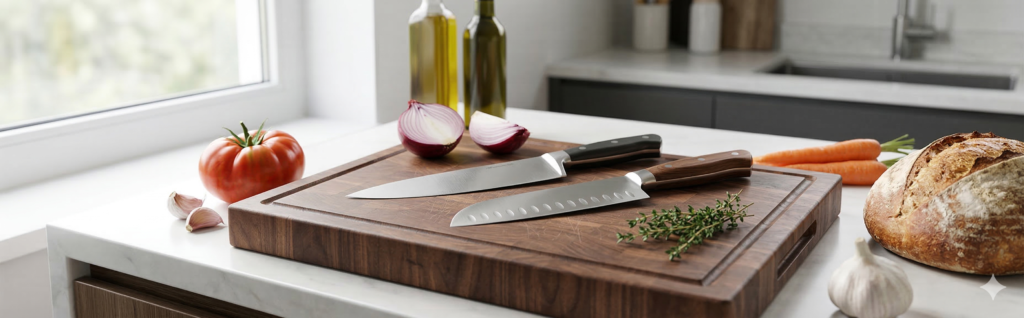
If you mostly cook vegetables, herbs, onions, garlic, chicken breast, fruit, and normal weeknight meals, you do not need a specialized arsenal. You need one dependable general-purpose knife.
If you constantly slice crusty bread, bagels, tomatoes, citrus, and soft-skinned produce, a serrated knife becomes much more important.
If you do a lot of peeling, trimming, coring strawberries, or fine detail work, you will want a paring knife too.
If you break down larger cuts of meat, trim fat frequently, or work with fish more often than the average home cook, a fillet or boning knife may be helpful later. But “later” matters. Most buyers should not begin there.
That is why most home kitchens work best with a simple core setup:
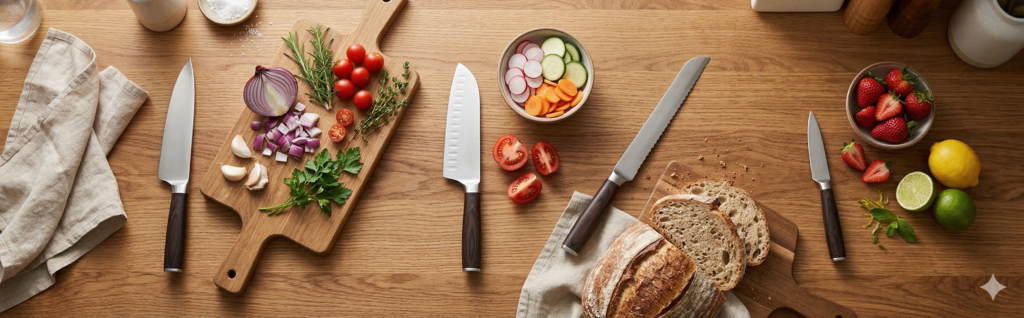
- One main knife: chef’s knife or santoku
- One small precision knife: paring knife
- One optional bread knife if you regularly slice bread or tomatoes
That basic setup usually beats an oversized knife block full of filler pieces you barely touch.
If you want a broader overview of which knives matter most before you buy, use this companion page: Best Kitchen Knives for Home Cooks
Chef’s Knife vs Santoku: Which One Fits You Better?
This is where many buyers get stuck, and honestly, for good reason. Both are valid. Both can handle most home cooking tasks. Both can be excellent first knives.
The difference is not just culture or branding. The difference is how they feel in motion.
Choose a Chef’s Knife if:
You like a rocking motion where the tip stays closer to the board while your hand rises and falls. This style feels natural for people who chop herbs, onions, celery, carrots, and mixed prep ingredients quickly. A 7- or 8-inch chef’s knife is often described as the most versatile size for everyday home cooking.
Chef’s knives usually feel more familiar to buyers in the U.S. market because they match the classic “all-purpose kitchen knife” image many people already have in mind.
Choose a Santoku if:
You prefer cleaner push cuts, downward slicing, and a lighter feeling blade. Santoku knives are often loved by people who prepare a lot of vegetables and want a knife that feels nimble, compact, and easy to control. Santoku knives are commonly discussed in the 5-to-7-inch range, which helps explain why they often feel more approachable to many home cooks.
The Truth Most Buyers Need
Neither one is automatically better.
The best knife is the one that matches your hand, your counter space, your prep style, and your confidence level.
If you are new, do not let internet debates pressure you into overthinking this. A good chef’s knife or a good santoku can both be the right answer.
The best way to choose the right kitchen knife is to match it to your hand size and cutting style.
Knife Size: Why Bigger Is Not Always Better
A lot of buyers assume a larger knife must be more professional or more powerful. In practice, bigger often just means harder to control.
For most home cooks, 7-inch and 8-inch knives sit in the most practical zone. They are long enough to handle onions, cabbage, sweet potatoes, and proteins, but still manageable on a normal cutting board. Sources aimed at everyday buyers consistently position 7- and 8-inch chef’s knives as the practical sweet spot, while shorter options may suit smaller hands or tighter spaces.
Here is the simplest way to think about size:
| Knife Size | Best For | Potential Downside |
|---|---|---|
| 5–6 inches | Small hands, tight spaces, cautious beginners | Can feel limited for larger prep |
| 7 inches | Great middle ground | Slightly less reach for large items |
| 8 inches | Best all-around size for many home cooks | May feel big to some beginners |
| 10 inches | Large prep and experienced users | Can feel intimidating or tiring |
The smartest choice is not the longest blade you can afford. It is the longest blade you can control comfortably.
If a knife makes you hesitant, your cooking slows down. If it feels secure, your prep improves.
The Material Question: Stainless, Carbon, or High-Carbon Stainless?
This is where buyers often get pulled into a rabbit hole.
You do not need a metallurgy degree to buy a kitchen knife well.
Stainless Steel
This is the easiest starting point for many people. Stainless steel is generally lower stress in everyday kitchens because it is more forgiving about moisture and routine care.
Carbon Steel
Carbon steel can get very sharp and is loved by enthusiasts, but it requires more discipline. It can discolor, patina, and rust if neglected. For some people, that is part of the appeal. For many casual home cooks, it is unnecessary work.
High-Carbon Stainless
This is often the most practical middle ground for everyday buyers because it combines easier care with strong cutting performance. General buyer guides frequently recommend high-carbon stainless as a strong everyday choice because it balances durability, corrosion resistance, and performance better than basic carbon steel for many households.
My view is simple:
If you are not already the kind of person who enjoys sharpening, drying, storing, and caring for tools carefully, do not buy a knife that demands a lifestyle you do not actually have.
The right knife should fit your routine. Your routine should not have to revolve around the knife.
Forged vs Stamped: What Actually Matters
This topic gets oversimplified all the time.
Forged knives often feel more solid and sometimes more balanced. Stamped knives are often lighter and can be more budget-friendly. But forged does not automatically mean better, and stamped does not automatically mean cheap junk.
A better question is this:
Does the knife feel stable, comfortable, and well made for the money?
Some people love a heavier, more planted knife. Others love a lighter blade that moves quickly. You are buying for feel, not for bragging rights.
A lighter stamped knife can be a better everyday tool than a heavy forged knife if it suits your style more naturally.
Handle Comfort: The Most Underrated Buying Factor
If you remember one thing from this article, remember this:
A knife that hurts your hand is a bad knife for you, even if the steel is amazing.
Handle comfort is where a lot of online shopping goes wrong. A knife can look elegant in product photos and still feel slippery, bulky, angular, or fatiguing after ten minutes of chopping.
When I think about a handle, I look for four things:
- Secure grip
- No pressure points
- Comfortable thickness
- Confidence when hands are slightly damp
That last one matters more than people think. Kitchens are not dry offices. Hands get wet. Ingredients get messy. A handle should still feel trustworthy in real cooking conditions.
Traditional Western handles often feel more familiar and fuller in the hand. Japanese-style handles can feel lighter and sometimes shift the balance in a way some buyers love. There is no universal winner.
Comfort beats reputation.
Balance and Weight: You Feel This More Than You Notice It
Many buyers cannot explain balance in technical terms, but they feel it immediately.
A knife that is too blade-heavy can feel tiring.
A knife that is too handle-heavy can feel odd and disconnected.
A knife with the right balance often disappears in your hand.
That is what you want.
Some people prefer a little weight because it gives the impression that the knife is helping them power through prep. Others prefer a nimble blade that feels fast and precise.
Neither camp is wrong.
The problem starts when people buy according to trends instead of buying according to comfort.
A good kitchen knife should make prep smoother, not more dramatic.
Edge Style: Plain Edge vs Serrated
If you are buying your first serious knife, a plain-edge chef’s knife or santoku is usually the best place to start.
Plain-edge knives handle the majority of daily kitchen work: slicing, chopping, dicing, mincing, and prep that benefits from clean, controlled cuts.
Serrated knives shine when the outside is tougher than the inside, such as bread with crust, tomatoes with delicate flesh, or certain fruits. Bread knives and serrated blades are commonly recommended for crusty loaves and delicate produce because the teeth can grip and cut without crushing the interior.
The mistake is thinking a serrated knife can replace a good main knife. It cannot.
A serrated knife is a specialist.
A chef’s knife or santoku is your core tool.
The “Real Life” Maintenance Test
A lot of knife advice sounds good until it collides with real life.
So here is the honest maintenance test I use:
Would you realistically do these things consistently?
- Wash the knife soon after use
- Dry it properly
- Store it safely
- Avoid tossing it loose in a drawer
- Use a reasonable cutting board
- Hone it occasionally
- Sharpen it when needed
If the answer is yes, you can consider more demanding options.
If the answer is no, choose a lower-maintenance knife.
This is not about discipline or prestige. It is about choosing a tool that still works well in the environment you actually live in.
Safe storage is not optional either. Buyer guides commonly recommend blocks, magnetic storage, or blade guards and warn against loose drawer storage because it hurts both safety and the edge.
The Wrong Cutting Board Can Ruin a Good Knife
People spend real money on a knife and then use it on whatever happens to be nearby.
That is how good edges die early.
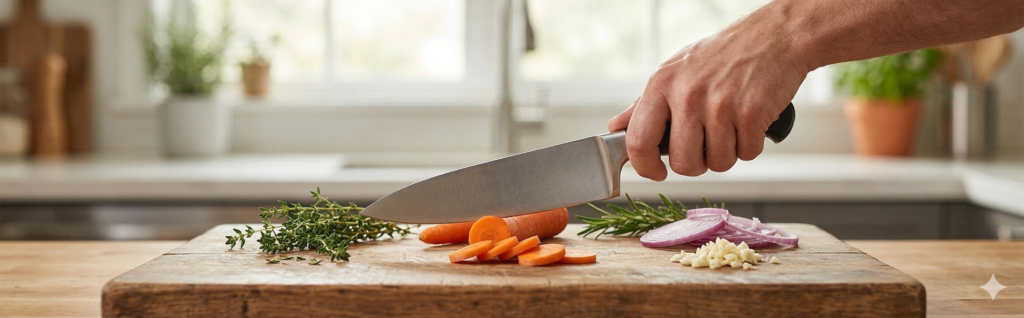
Glass, stone, ceramic, and other very hard surfaces are rough on knife edges. Wood and quality plastic are usually much more forgiving for everyday use. That does not mean your board has to be expensive. It means it should not fight your knife.
A better knife on a bad surface becomes a disappointing knife quickly.
How to Read Knife Reviews Without Getting Manipulated
Online reviews help, but only if you know how to read them.
Too many buyers scroll through five-star praise and assume that is enough. It is not.
I trust patterns, not hype.
Here is how I read knife reviews:
First, I sort by most recent when possible. Product quality can shift over time. Manufacturing changes, packaging changes, and quality control can drift.
Second, I read three-star reviews carefully. Those reviews often reveal the most useful reality because they usually come from buyers who saw both strengths and weaknesses.
Third, I scan for repeated complaints, not emotional one-off rants. The most useful review patterns sound like this:
- Dulls faster than expected
- Handle gets slippery
- Edge chipped during ordinary kitchen use
- Rust spots appeared too quickly
- Fit and finish felt rough
- Knife arrived warped or poorly ground
Fourth, I pay attention to mismatch language. This matters a lot. Sometimes the knife is not bad. It just did not fit the buyer.
Comments like these are helpful:
- “Too heavy for my hand”
- “Too short for bigger prep”
- “Felt slippery”
- “I wanted more knuckle clearance”
- “Harder to sharpen than I expected”
That tells you who the knife may not suit.
Product Examples Buyers Commonly Compare
The original recovered post already pointed to several recognizable examples in this category, including Victorinox Fibrox Pro, Wüsthof Classic, MAC Professional, Mercer Millennia, and Victorinox Swiss Classic Paring.
Those names come up often because they sit in understandable buyer lanes:
- Victorinox Fibrox Pro: practical, budget-friendly, frequently praised for value
- Wüsthof Classic: more premium, classic Western feel
- MAC Professional: often treated as a strong performance-focused hybrid option
- Mercer Millennia bread knife: popular value pick for serrated use
- Victorinox Swiss Classic paring knife: simple, practical, and approachable
Recent review and recommendation sources continue to highlight MAC and Victorinox in strong value and performance conversations, with MAC appearing as a top-tested pick in one source and Victorinox being praised for edge retention at low cost in another.
That does not mean those are the only good knives. It means they are useful reference points for understanding categories.
My Practical Buying Table for Home Cooks
| If You Are This Buyer | Start Here | Why |
|---|---|---|
| Complete beginner | 7- or 8-inch chef’s knife | Most versatile and easiest starting point |
| Vegetable-heavy cook | Santoku | Efficient, nimble, often easier for push cuts |
| Small-hand buyer | 6- or 7-inch knife | Easier control, less intimidation |
| Bread-heavy household | Main knife + bread knife | Serrated edge helps where plain edges struggle |
| Minimalist buyer | One chef’s knife + one paring knife | Covers most daily needs without waste |
| Knife enthusiast | Add specialty knives later | Better to learn your preferences first |
Why Big Knife Sets Are Usually a Bad First Buy
This is one of the most common buying mistakes.
Large knife sets look complete. They look premium. They look like value.
But many buyers end up paying for a wooden block full of knives they rarely use.
In real life, most people keep reaching for the same one or two knives over and over again.
That is why I almost always prefer this approach:
Buy one good main knife first.
Then add a paring knife.
Then add a bread knife if your cooking actually needs it.
Only after that should you consider specialty blades.
This saves money, reduces clutter, and usually leads to better quality per dollar.
The Biggest Mistakes People Make When Choosing a Kitchen Knife
1. Buying for looks instead of feel
Beautiful handles, polished steel, and dramatic branding can seduce almost anyone. But appearance does not prep dinner.
2. Choosing the wrong size
A knife that is too large can feel unsafe. A knife that is too small can feel limiting. Size is a real usability factor, not a cosmetic one.
3. Confusing prestige with practicality
Not every home cook needs a blade designed for enthusiasts. Sometimes the boring answer is the best answer.
4. Ignoring maintenance reality
A demanding knife in a low-maintenance household is usually the wrong purchase.
5. Overtrusting star ratings
Stars alone are shallow. Pattern recognition is deeper.
6. Buying a set too early
You do not need twelve pieces to cut onions well.
7. Forgetting storage
Loose drawer storage is bad for safety and bad for the edge. Safe storage matters.
Who Should Skip Expensive Knives?
This section matters because not every upgrade is smart.
You should probably skip premium kitchen knives, at least for now, if:
- You rarely cook
- You are still learning your cutting style
- You do not maintain knives consistently
- You are rough with storage
- You are mainly attracted by branding
- You have not yet used a solid mid-range or value knife long enough to know what you want improved
Expensive knives make more sense when you can clearly explain what you are paying extra for.
Good reasons to upgrade include:
- Better handle comfort
- Better balance
- Better edge retention
- Better fit and finish
- A blade profile that matches your style more precisely
- Greater long-term satisfaction because you cook often
Bad reasons to upgrade include:
- Social media hype
- Aesthetic pressure
- Wanting to imitate professional kitchens without having the same needs
Who Should Consider Spending More?
Now the opposite side.
Paying more may be worth it if you cook frequently and can clearly feel where cheaper tools frustrate you.
That might mean:
- You prep dense produce often
- You cook most days
- You want cleaner, more confident cuts
- You notice handle discomfort quickly
- You want a knife you will use for years, not months
- You already know you prefer a certain weight or profile
The key is intentional upgrading.
Upgrade because you understand the benefit, not because the internet made you feel inadequate.
A Smarter Way to Decide in 5 Minutes
If you still feel stuck, use this fast decision flow:
If you want one all-purpose knife and do not know where to start, buy a chef’s knife.
If you dislike heavy tools or prefer push cutting, buy a santoku.
If your hands are smaller or you are nervous around large blades, stay closer to 6 or 7 inches.
If you want lower stress maintenance, choose stainless or high-carbon stainless.
If you bake bread or slice tomatoes constantly, add a bread knife.
If you mainly do small detail work, add a paring knife.
That is it. The best decision is often much simpler than the market makes it sound.
How I Would Build a Smart Starter Setup
If I were helping a normal home cook start from scratch, I would usually build the kit like this:
Option 1: The Minimalist Setup
- 1 chef’s knife or santoku
- 1 paring knife
Option 2: The Practical Family Setup
- 1 chef’s knife
- 1 paring knife
- 1 bread knife
Option 3: The Upgrade Path
- Start with a solid all-purpose knife
- Use it for a few months
- Notice what feels missing
- Then add only what solves a real problem
That path usually leads to fewer regrets and better choices.
Better Than Competitors Because It Solves the Actual Buying Problem
A lot of knife content online makes one mistake: it jumps too quickly into product lists without helping readers understand themselves first.
That leads to poor buying decisions.
This guide is better for the decision stage because it focuses on fit:
- Fit to your cooking habits
- Fit to your hand
- Fit to your maintenance style
- Fit to your budget
- Fit to your kitchen reality
That is what actually prevents wasted money.
The best buying guide is not the one with the longest list of knives. It is the one that helps you eliminate the wrong choice before checkout.
FAQ: Kitchen Knife Buying Questions
Is an 8-inch chef’s knife too big for beginners?
Not necessarily. For many home cooks, 7- and 8-inch chef’s knives are the most practical range. But if you have smaller hands, limited space, or lower confidence, a slightly shorter knife may feel better.
Is santoku better than chef’s knife?
No. It is different, not universally better. Santoku often suits push-cut users and vegetable-heavy prep well. Chef’s knives often suit rocking motions and classic all-purpose use well.
Should I buy a full knife block?
Usually not as a first serious purchase. Most households use a small number of knives repeatedly, so starting with one good main knife and one or two supporting knives is often smarter.
Is carbon steel worth it?
It can be, but only if you are comfortable with the extra care. Many home cooks are better served by stainless or high-carbon stainless because maintenance is easier.
Do I need a bread knife?
Only if you regularly slice crusty bread, bagels, or delicate produce where serration helps. Otherwise, it may not be urgent.
What is the safest way to store knives?
Use a block, magnetic holder, sheath, or blade guard. Avoid leaving knives loose in drawers whenever possible.
Final Recommendation
If you are trying to choose the right kitchen knife without wasting money, here is my honest recommendation:
Do not start with prestige.
Do not start with big sets.
Do not start with steel obsession.
Do not start with internet arguments.
Start with usefulness.
For most people, that means choosing a comfortable chef’s knife or santoku in a practical size, with a handle that feels secure and a material you can realistically maintain. Then build from there only if your cooking habits justify more.
If you want the companion roundup with broader buying guidance and examples, read: Best Kitchen Knives for Home Cooks
You can also browse the main site here: Buyers Choice Lab
And your author page is here if you want to reinforce authorship and internal relevance: Prime Nestora