Most of us have bought “helpful” kitchen tools that sounded smart in theory, then ended up buried in a drawer because they were annoying to use, messy, slow, or simply not worth the effort. Knife sharpeners are one of the biggest offenders.
In theory, a sharpener should save time and make cooking easier. In real life, the wrong sharpener turns into a project. It asks for too much setup, too much confidence, too much storage space, or too much patience. And once that happens, you go right back to forcing a dull knife through onions, tomatoes, herbs, chicken, and everything else that should feel easier than it does.
That is exactly why I wanted this page to be different from a generic “best knife sharpeners” roundup. I am not trying to impress hobbyists with the most technical option in a perfect world. I am trying to help normal home cooks find the kind of sharpener they will actually keep using in a real kitchen, on a real weeknight, with real time pressure.
If you are still building your overall knife setup, I strongly recommend pairing this guide with Best Kitchen Knives for Home Cooks and How to Choose the Right Kitchen Knife. Those pages help with the knife itself. This page is about keeping that knife useful, safe, and pleasant to work with week after week.
Quick answer
The best knife sharpener is not the one that sounds the most advanced. It is the one you will realistically use often enough to keep your knife from becoming frustrating.
- Busy cooks: electric 3-stage sharpeners are usually the easiest practical win.
- Small kitchens: manual pull-through sharpeners often get used the most because they are tiny and low fuss.
- Careful home cooks: guided angle systems offer repeatability without demanding perfect freehand skill.
- Maintenance-focused users: ceramic rod systems can be excellent when you stay ahead of dullness.
- Enthusiasts: belt systems can be powerful, but they are not the smartest first choice for everyone.
My simple rule: buy for your real routine, not your fantasy self.
Why Most Knife Sharpener Advice Fails in Real Kitchens
Most knife sharpener advice falls apart because it usually leans too far in one of two directions. The first version is the generic affiliate roundup: ten products, quick blurbs, almost no context, and very little help choosing what fits your kitchen. The second version is enthusiast content: more precise, sometimes more knowledgeable, but built around the assumption that you want sharpening to become a hobby.
Most home cooks do not live at either extreme. They do not want shallow advice, but they also do not want to study bevel geometry before dinner. They want a practical answer to a practical problem. Their knife is dragging, slipping, crushing soft produce, or making prep more tiring than it should be. They want that fixed in a way they can maintain without resentment.
That is why I think the wrong question is, “Which sharpener is the most impressive?” The better question is, “Which sharpener improves daily cooking with the least friction?” That subtle shift changes everything. Suddenly, speed matters. Cleanup matters. Counter space matters. Confidence matters. The difference between a once-a-year rescue tool and an every-few-weeks maintenance tool matters.
It also explains why so many sharpeners become drawer clutter. Plenty of products can create a sharper edge on paper. Far fewer feel easy enough, calm enough, and useful enough that people actually keep using them. And when a kitchen tool does not fit the rhythm of the home, it almost never earns long-term space.
So this article is built around usefulness, not hype. I want to help you understand what problem you actually have, what kind of routine you are willing to maintain, and which type of sharpener deserves space in your kitchen based on real life rather than marketing language.
Honing vs. Sharpening: Solve the Right Problem First
One of the biggest reasons people buy the wrong knife sharpener is that they are trying to solve the wrong problem. They think everything falls under “sharpening,” when in reality there are two different jobs that often get blended together: honing and sharpening.
Honing is usually about maintenance. It helps the edge feel straighter, cleaner, and more cooperative in everyday use. It is the kind of action that can help when the knife still basically works, but feels less smooth, less confident, or less pleasant than it should.
Sharpening is more corrective. It is what you need when the knife has moved beyond “a little tired” and into “this is making prep objectively worse.” If your blade slips on tomato skin, crushes herbs, or asks for much more pressure than before, you are not dealing with a minor tune-up anymore. You probably need actual sharpening, not just a quick maintenance pass.
This matters because some tools are better at upkeep, while others are better at recovery. A ceramic rod system can be excellent when you are staying ahead of the problem. A guided system can be great when you want consistency and more deliberate sharpening. A quick electric unit can be ideal when your biggest obstacle is motivation and time. But if you mix up those roles, even a good product can feel disappointing.
I think the easiest practical question is this: Do you need a rescue tool, a maintenance tool, or a system that gives you some of both? If you answer that honestly, you immediately narrow the field. You stop buying based on reputation alone and start buying based on your actual kitchen problem.
And that makes a huge difference, especially if you only own one main chef’s knife. In that case, every small edge problem is magnified because your entire prep experience depends on one blade. If that sounds like your situation, take a minute to compare this page with How to Choose the Right Kitchen Knife so the knife itself and the maintenance plan actually fit each other.
15° vs. 20° Edges: Why Angle Matters More Than It Sounds
You do not need to become obsessive about edge geometry to buy a better sharpener, but a basic understanding of angle helps avoid bad matches. In broad terms, many Western kitchen knives are associated with edge angles around 20 degrees, while many Japanese-style knives and thinner-feeling blades are associated with edges closer to 15 degrees. The specifics vary by knife, but that general distinction is still useful.
Why does that matter? Because some sharpeners are built around more fixed approaches. If the sharpener tends to favor one kind of edge profile and your knife is happiest with another, the tool may still “work,” but the result may not feel ideal. That does not mean every home cook needs a technical seminar. It simply means compatibility is worth thinking about before you buy.
For a lot of people, the best move is to stay practical. If you mostly use mainstream household kitchen knives, a broad range of sharpeners can make sense. If you use thinner Japanese-style knives or care more about preserving a certain cutting feel, guided systems and more deliberate approaches become more attractive. If you are not sure what you own, repeatability and ease of use usually matter more than chasing theoretical perfection.
That is another reason I dislike one-size-fits-all knife advice. The right sharpener depends on the blade, the kitchen, and the user. A person with one everyday chef’s knife and limited patience needs a very different answer from someone who enjoys a more involved maintenance ritual.
If your knife-shopping stage is still messy, this is a good point to bounce briefly to Best Kitchen Knives for Home Cooks. Sharpener choice gets easier when your knives and your cooking style already make sense together.
My Real-Life Fit Framework: What Makes a Sharpener “Actually Work”
When I think about whether a knife sharpener actually works in daily life, I use a simple five-part framework. This is the filter I wish more buying guides used, because it reflects how people really behave in kitchens rather than how they behave in theory.
1) Speed
If sharpening feels like a half-hour event, people postpone it. Once they postpone it long enough, the knife becomes truly dull, which makes the next session feel even heavier. A sharpener that gets you back to a usable edge quickly has a huge practical advantage simply because it lowers resistance.
2) Repeatability
Most home cooks do not need perfect freedom. They need a process they can repeat without guessing whether they are doing it wrong. Systems that reduce uncertainty tend to feel better over time because they create confidence.
3) Footprint
Small kitchens expose every flaw in a tool. If the sharpener is bulky, awkward, or messy, it has to be extremely compelling to survive. If it is compact and easy to store, it has a far better chance of becoming part of a routine.
4) Maintenance realism
Some people are willing to maintain their knife before it gets bad. Others wait too long every time. There is no shame in that. But it matters. Maintenance-oriented systems only feel magical if your habits match them.
5) Stress level
This is the hidden factor almost nobody talks about. Does using the tool feel calm and obvious, or does it feel like one more thing you are trying to avoid? The sharpeners that stay useful over time are usually the ones that feel emotionally cheap to use. That matters more than a lot of people realize.
| Type | Best For | Why It Works in Real Life | Main Tradeoff |
|---|---|---|---|
| Electric 3-stage | Busy kitchens, frequent cooks | Fast, guided, lower hesitation | Less hands-on control |
| Manual pull-through | Small kitchens, beginners | Tiny, simple, quick to reach for | Not the favorite choice for precision purists |
| Guided angle system | Careful home cooks | Repeatable without perfect freehand skill | Needs more setup and intention |
| Ceramic rod system | Maintenance-minded users | Clean, controlled, great for upkeep | Less ideal for badly neglected knives |
| Belt system | Enthusiasts, tinkerers | Powerful and versatile | More involvement than many kitchens need |
Situations Where a Knife Sharpener Helps Immediately
Weeknight cooking when you are already tired
This is where dull knives stop being a minor annoyance and become emotional friction. You are hungry, moving quickly, and trying to get through prep with as little drama as possible. But instead of clean cuts, you get slipping tomato skin, crushed herbs, rough onion cuts, and that subtle feeling that cooking is more work than it should be.
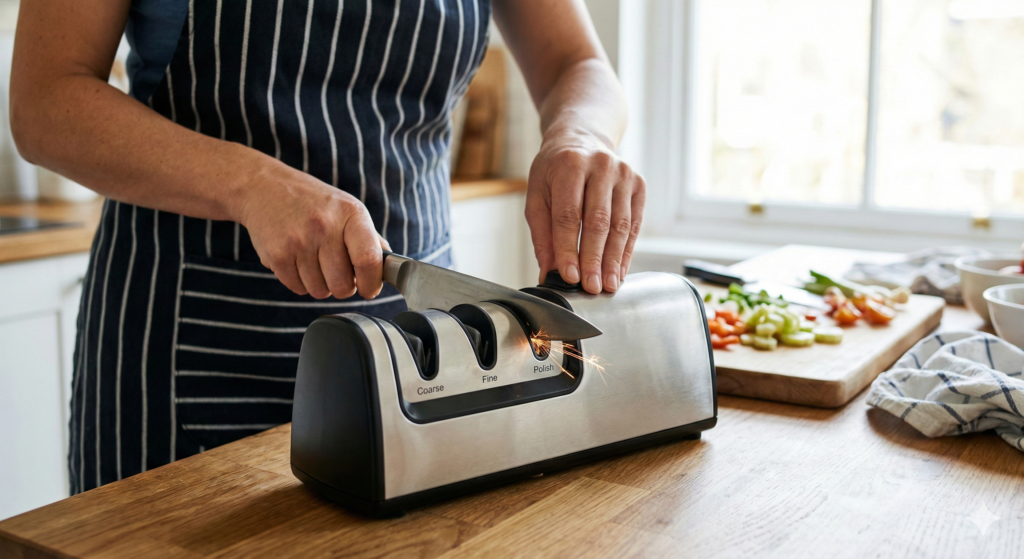
In that moment, a sharpener that works in one or two minutes has real value. You do not need a ceremony. You need relief. That is why electric 3-stage systems and quick manual sharpeners remain so relevant for ordinary kitchens. Their biggest strength is not romance. Their biggest strength is that they lower the barrier to doing the job.
Meal prep sessions and longer chopping blocks
Some knives feel “good enough” for one onion and suddenly feel miserable halfway through a real prep session. Once you are chopping vegetables, trimming proteins, and slicing herbs in sequence, small weaknesses become obvious. This is where repeatability matters more than maximum bragging rights. You want an edge that stays controlled and predictable through a lot of repetitive prep.
Guided systems and certain well-designed electric systems shine here because they help reduce inconsistency. They make it easier to maintain a stable result without demanding perfect technique every time you sharpen.
Apartments and compact kitchens
Small kitchens are brutal honesty machines. If a tool is messy, awkward, or annoying to store, it quickly becomes dead weight. That is why compact sharpeners often beat more technically impressive options in apartment life. The smallest amount of hassle matters more when every drawer, every shelf, and every extra minute already feels expensive.
For a lot of people, a compact pull-through sharpener is not the “best in theory” option. It is simply the option most likely to be used. And in practical cooking, that often matters more.
Households where more than one person cooks
In a shared kitchen, simplicity gains extra value. If only one person understands the sharpening system, maintenance depends too heavily on one person’s energy, schedule, or mood. Straightforward tools can make the whole kitchen run better because they reduce hesitation and confusion.
When safety becomes the real issue
Dull knives do not just feel bad. They often create more force, more pressure, and more slippage. A sharper knife deserves more respect, but it also tends to feel more controlled during normal prep when it is being used properly. That is a strong argument for getting ahead of dullness instead of waiting until the knife feels terrible.
Knife Sharpeners Worth Considering by Type
Instead of pretending there is one universal winner, I think it is more honest to break sharpeners down by type. Different tools solve different versions of the same problem. That means the smartest buy depends less on hype and more on behavior.
1) Electric 3-stage sharpeners: the easiest answer for busy kitchens
Electric 3-stage sharpeners make the most sense when your biggest obstacle is friction. If you cook often, get annoyed by maintenance tasks, and just want your knife to stop feeling miserable, this category is often the easiest practical answer.
Their real strength is not glamour. It is momentum. You do not have to think as much about angle control. You do not have to lay out a whole sharpening setup. You do not have to convince yourself to spend half an hour on the process. You bring out the machine, follow the stages, and move on.
That is especially valuable in family kitchens and for people who prep food several times a week. When sharpening becomes emotionally cheap, it stops getting postponed. And when it stops getting postponed, your knives stay in a much happier place.

Chef’sChoice 15XV EdgeSelect Professional Electric Knife Sharpener
A strong fit for cooks who want guided sharpening, less guesswork, and a routine that feels fast enough to repeat.
- 3-stage sharpening approach
- built around guided sharpening and finishing/stropping
- good match for frequent cooking and quick edge resets
Who should be cautious with this type? People who want more manual control or who really care about preserving a very specific edge feel. But for the average home kitchen, electric 3-stage sharpeners win because they make action easier than procrastination.
2) Manual pull-through sharpeners: the most realistic “I’ll actually use this” option
Manual pull-through sharpeners survive because they solve a deeply human problem: sometimes you want the smallest possible amount of effort between “my knife feels dull” and “my knife feels better.” They are compact, simple, and usually easy to store. That combination gives them staying power in real homes.
I think this category is especially strong for apartment kitchens, casual home cooks, and people who know they will delay maintenance the moment it starts feeling too elaborate. A perfect sharpening theory means very little if you never do the work.
That does not mean every pull-through sharpener is the best choice for every knife. It means this category deserves more respect than it often gets. In many homes, the tool that gets used wins over the tool that is technically superior but emotionally expensive.

Rada Cutlery Quick Edge Knife Sharpener
A compact option for kitchens where speed, low fuss, and easy storage matter more than ritual.
- tiny footprint and easy drawer storage
- good fit for quick touch-ups and simple upkeep
- works best when convenience is the deciding factor
If you care a lot about angle preservation and precise geometry, this may not be your favorite lane. But if your main goal is to keep prep from feeling annoying in a small or busy kitchen, manual pull-through sharpeners can be a very rational buy.
3) Guided angle systems: the sweet spot between convenience and control
Guided angle systems appeal to the home cook who wants something more deliberate without turning sharpening into a full craft. This is the category I think makes the most sense for people who care about consistency, like structure, and are willing to spend a few extra minutes for a more controlled result.
What I like about guided systems is that they reduce the doubt factor. A lot of sharpening frustration comes from not knowing whether you are maintaining a consistent angle or whether you are making the problem worse. Guided systems lower that anxiety by giving the process a more teachable, repeatable feel.
They are not the fastest answer for a chaotic weeknight. But that is not the point. The point is confidence. If you are the kind of person who values repeatability more than raw speed, guided systems can feel like the smartest compromise in the entire category.
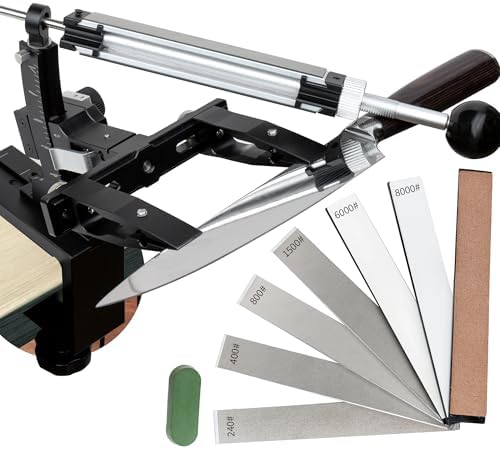
CWOVRS Knife Sharpening System Precision Adjust
A stronger fit for home cooks who want repeatability, more control, and a more intentional sharpening routine.
- guided angle sharpening approach
- useful when angle confidence is the biggest obstacle
- good bridge between convenience and control
The main drawback is simple: it asks more of you. If you know you will avoid anything that needs setup or a bit of patience, a guided system may be objectively good and still be wrong for your life. That does not make it worse. It just makes it more dependent on your habits.
4) Ceramic rod systems: excellent for maintenance-minded cooks
Ceramic rod systems are underrated because they tend to be judged by the wrong standard. They are often not the most dramatic rescue tool for a truly neglected knife, but that is not what makes them valuable. Their value is that they support a cleaner, calmer maintenance rhythm for people who prefer keeping the edge in shape before the knife becomes awful.
If you like tidy routines, want a more controlled feel, and do not mind handling maintenance before the knife becomes deeply frustrating, this category can make a lot of sense. It is especially attractive to cooks who already have some respect for knife care but do not want a bulky machine or a large bench setup.
I would especially consider ceramic rod systems if your main complaint is not “my knife is completely dead,” but rather “I want to stop letting it get that bad in the first place.” That is the right mindset for this lane. In other words, they work best when you use them early enough and often enough.
The flip side is important: if your knife has already been ignored for a long time, this category may feel underwhelming as a first intervention. That does not mean it is a weak option. It just means it is more maintenance-first than rescue-first.
For people who enjoy that lighter, more regular rhythm, ceramic systems can feel elegant. They reward steadiness rather than panic. And in a kitchen where habits are more important than occasional heroics, that can be a real advantage.
5) Belt systems: powerful, flexible, and usually better for enthusiasts
Belt systems can be excellent, but I think they are also the easiest category to overbuy. The appeal is obvious: power, adjustment, range, and a strong sense of capability. For someone who genuinely enjoys tools and process, that can be exactly the right kind of purchase.
The problem is that many people are not buying a sharpening setup because they want more gear. They are buying because they want prep to feel better again. If that is your situation, a belt system can become more “thing” than solution. It may be capable, but still too much for your actual needs.
I think belt systems make the most sense when you truly want involvement. You enjoy adjustment. You enjoy dialing in a process. You have more than casual interest in maintenance. In that context, they can be impressive and rewarding.
But if your real goal is speed, simplicity, and less kitchen friction, you probably do not need this much tool. That does not make the category bad. It just means it belongs to a narrower kind of buyer.
Who Should Skip Each Type
Sometimes the best buying decision is not asking what fits you. It is identifying what you should probably avoid. This category gets much easier when you stop pretending every tool is meant for every person.
Skip electric 3-stage sharpeners if…
- you want more manual control over the sharpening process
- you care deeply about preserving a particular edge feel
- you enjoy a more deliberate, hands-on maintenance ritual
Skip manual pull-through sharpeners if…
- you are highly focused on angle precision
- you own knives you want to maintain more carefully over time
- you dislike compromise more than you dislike setup
Skip guided angle systems if…
- you want a one-minute answer before cooking
- you know you avoid anything that needs setup
- you are buying for a household that values maximum simplicity
Skip ceramic rod systems if…
- your knives are already seriously dull
- you want a dramatic reset faster than a routine
- you know you do not maintain knives regularly enough for a maintenance-first tool
Skip belt systems if…
- you want less gear, not more
- you are not interested in a more involved sharpening process
- your real problem is everyday kitchen friction, not lack of power
Common Buying Mistakes That Make a Sharpener Feel Useless
Mistake 1: Buying for your fantasy self
This is probably the biggest one. People buy the sharpener that matches the version of themselves they imagine they might become: the more technical cook, the patient weekend maintainer, the person who enjoys a ritual. Then ordinary life shows up, and the tool becomes guilt with a handle.
Mistake 2: Waiting too long
The more neglected the edge becomes, the heavier the whole experience feels. Maintenance is easier than rescue. But many people wait until every prep session feels annoying, then conclude the sharpener itself is the problem.
Mistake 3: Ignoring kitchen size and cleanup tolerance
Storage is not a minor detail. It is part of the product. In a small apartment, a slightly awkward tool can become unbearable surprisingly fast.
Mistake 4: Expecting one tool to solve every problem perfectly
Some sharpeners excel at fast touch-ups. Some are better at controlled restoration. Some are ideal for maintenance. Some are built for people who enjoy more involvement. No type wins every job.
Mistake 5: Forgetting the knife itself
Sometimes the frustration is not just the sharpener. Sometimes it is the overall knife setup. If your main knife does not suit your cooking habits, no maintenance plan will feel fully satisfying. That is why it helps to keep this guide connected to Best Kitchen Knives for Home Cooks and How to Choose the Right Kitchen Knife.
Mistake 6: Treating sharpening like a one-time event
Even a good sharpener is not magic. The real win comes from a rhythm you can repeat. Consistency is what makes the tool start “working” in everyday life.
A Sustainable Maintenance Rhythm That Works for Normal People
A lot of people ask how often they should sharpen. I think a better question is how to make maintenance feel easy enough that it actually happens. The answer is usually not a rigid calendar. It is a small, repeatable rhythm.
Here is the pattern I think makes the most sense for many households:
- Pay attention to soft-produce performance. Tomatoes, herbs, peppers, and onions reveal edge decline early.
- Act before frustration spikes. It is easier to maintain than to rescue.
- Match the intervention to the problem. Not every dull-feeling moment requires a major sharpening session.
- Keep the routine emotionally cheap. Low-fuss tools are used more often.
- Store the knife properly after sharpening. A cleaner edge will not stay happy if the knife gets knocked around in a drawer.
This is why I do not think discipline alone is the answer. Better systems reduce friction. And when friction goes down, consistency tends to go up naturally. That is where a tool starts earning its place.
If your whole knife setup still feels uncertain, it is worth reviewing How to Choose the Right Kitchen Knife because a better match between knife style, cooking style, and maintenance style makes every part of the experience easier.
Safety Habits That Matter More Than People Think
Sharper knives deserve respect, but sharpening should not feel mysterious. A few sensible habits do most of the work:
- Never run your finger along the edge to “test” sharpness.
- Wipe the blade carefully after sharpening to remove residue.
- Keep children out of the kitchen during the sharpening process.
- Store sharpened knives safely in a block, with a guard, on a magnetic strip, or in a proper insert.
- Remember that a dull knife can be risky too because it often requires more force and offers less control.
One reason I think sharpening matters is that good maintenance usually gives you more predictable movement during prep. Better edges often make cutting feel calmer, not more chaotic, as long as you respect the tool.
Best by User Type and Kitchen Scenario
“I cook most nights and I want the easiest practical answer.”
Go electric 3-stage. You are paying for reduced hesitation. If weeknight friction is the problem, the fastest usable answer is usually the best answer.
“I live in a small apartment and hate clutter.”
Go manual pull-through. In a compact kitchen, small and easy often beats technically superior but inconvenient.
“I want consistency, but I don’t want to become a sharpening nerd.”
Go guided angle. This is the clearest middle ground between low-effort convenience and controlled repeatability.
“I already care about knife upkeep and want a cleaner maintenance rhythm.”
Consider a ceramic rod system. This lane makes the most sense when you like staying ahead of the problem rather than rescuing a neglected edge.
“I genuinely enjoy tools and want more involvement.”
Then belt systems may actually be right for you. The key word there is genuinely. If that sounds exciting instead of exhausting, this category deserves attention. If it sounds tiring, do not force it.
Why This Page Can Be Better Than a Generic “Best Knife Sharpeners” Roundup
I think this page becomes more valuable when it stops trying to impress everyone and instead helps normal cooks make a better decision faster. A lot of top-of-funnel content on this topic focuses too heavily on ranking products and not enough on matching tools to behavior. That is the opportunity here.
A more useful page does not just say what exists. It explains what problem each category solves, what kind of routine it fits, who should skip it, and why certain sharpeners end up unused even when they are technically good. That is more helpful than simply listing features and calling it a buying guide.
I also think this page wins by staying honest about tradeoffs. There is no universal answer. There is only the right answer for a certain kitchen, a certain knife setup, and a certain kind of person. When readers feel that honesty, the advice usually becomes easier to trust.
That is what “actually work” should mean here: not the most extreme result in a vacuum, but the best return on time, effort, storage, and real behavior.
FAQ: What Home Cooks Still Want to Know
Are knife sharpeners actually worth buying?
Yes, if the sharpener matches your routine. The wrong one becomes clutter. The right one can make prep easier, faster, and less frustrating for a long time.
Is a pull-through sharpener bad for every knife?
No. The criticism usually comes from people who care a lot about precision. For many everyday kitchens, the more practical question is whether the sharpener helps maintain a usable edge consistently. In that context, compact pull-through sharpeners can make a lot of sense.
Are electric sharpeners too aggressive?
They can feel more interventionist than maintenance-oriented tools, but that does not automatically make them wrong. For busy cooks, the practical value of speed and lower hesitation is often the whole point.
Do I need a honing rod if I buy a sharpener?
Maybe. Some people like having a quick maintenance option plus a stronger sharpening option. Others prefer one solution that feels simple enough to keep using. It depends on your knives and how involved you want your routine to be.
How do I know it is time to sharpen?
When prep starts feeling worse. If the knife drags, slips, crushes softer ingredients, or makes you push harder than you used to, that is your clue.
What if I only own one main chef’s knife?
Then maintenance matters even more, because that one knife affects almost everything you prep. In many cases, a practical, easy-to-repeat sharpener is exactly the right purchase.
Should beginners buy a guided system or something simpler?
If you want the easiest path to action, go simpler. If you are comfortable with a little setup and care more about repeatability, a guided system can be a great beginner-friendly middle ground.
What is the biggest mistake people make with sharpeners?
Buying for identity instead of behavior. The best sharpener is not the one that flatters your taste. It is the one you will realistically keep using.
Build the full knife setup
If you still need help choosing the knife itself, go here first: Best Kitchen Knives for Home Cooks.
If you want a more decision-focused buying guide before sharpening even becomes part of the conversation, go here: How to Choose the Right Kitchen Knife.
Final Verdict
A knife sharpener only “actually works” if it fits the life of the person using it.
That is the whole point of this page. Not every kitchen needs the same solution. Not every cook wants the same level of control. Not every routine can support the same amount of maintenance. A tool is only good if it matches the reality of the home it is entering.
If you are busy, electric 3-stage sharpeners are often the easiest practical answer. If you live in a small kitchen and hate clutter, manual pull-through sharpeners are often the smartest buy. If you want repeatability without becoming a freehand sharpening expert, guided angle systems deserve serious attention. If you like maintenance and staying ahead of the problem, ceramic rod systems can be excellent. If you genuinely enjoy tools and process, belt systems can make sense.
But none of these categories wins just because it sounds advanced. The winner is the one that keeps your knife useful without making you resent the routine.
That is what separates a practical sharpener from a drawer sharpener.
Buy for your actual kitchen. Buy for your actual patience. Buy for your actual habits. That is how you end up with a sharpener that really works.
Disclosure: As an Amazon Associate, this site may earn from qualifying purchases.