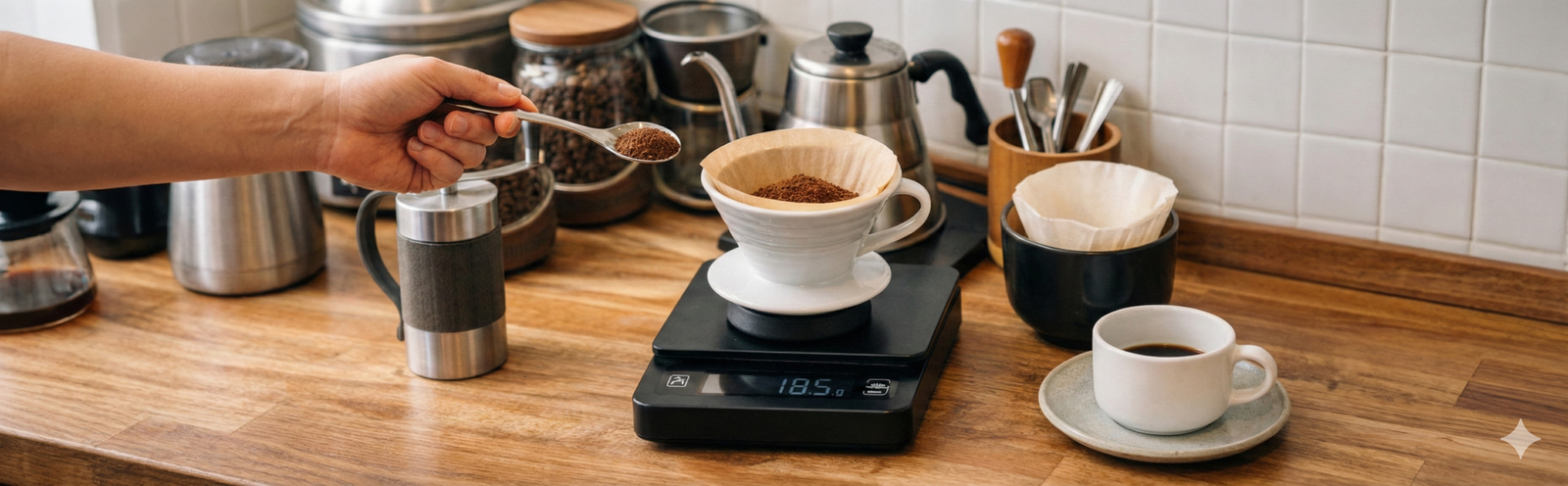
Most of us have bought kitchen gadgets with good intentions, only to watch them disappear into a cabinet after two or three uses. Coffee accessories are especially vulnerable to this. They photograph well, sound smart in product listings, and promise “barista-level” results. But real kitchens are not showrooms. Real kitchens are rushed, shared, cramped, messy, and often half-awake at 6:45 a.m.
That is why the best coffee accessories are not necessarily the most advanced ones. They are the tools that quietly remove friction from your routine. They help you move faster, waste less coffee, clean up more easily, and make a more consistent cup without turning a normal morning into a hobby project.
This guide focuses on coffee accessories that actually fit real life. Not the ones that sound impressive on social media. Not the ones that only make sense if you love tweaking every variable. The ones that keep earning their place on the counter because they solve a real daily problem.
If your main goal is understanding how tools affect flavor and extraction, read our companion guide on how coffee accessories improve flavor without upgrading your machine. This article takes a different angle: what gets used consistently in everyday routines, and why.
Quick answer / TL;DR
The coffee accessories most people actually keep using are the ones that do at least one of these four things:
- make mornings faster
- make results more repeatable
- fit small spaces without becoming clutter
- reduce cleanup or wasted coffee
For most homes, that means a good grinder, a simple scale, and only a few method-specific extras after that. A kettle matters if you actually brew manually. A tamper matters if you actually make espresso. A cold brew maker matters if you genuinely drink cold brew every week. The mistake is buying tools for an imaginary future version of yourself instead of the routine you already have.
What makes a coffee accessory “real-life useful”?
A useful coffee accessory does not have to be revolutionary. It just has to make the normal routine easier enough that you reach for it automatically. That sounds obvious, but it is where most buying mistakes happen. Many people shop for potential instead of fit. They imagine a slower, tidier, more experimental version of their mornings than the one they actually live.
To keep this grounded, it helps to judge accessories through a simple framework.
The 4F framework: Fit, Friction, Frequency, Footprint
Fit: Does the accessory match how you already make coffee, or does it force a new ritual you are unlikely to maintain?
Friction: Does it remove steps, guesswork, or mess? Or does it add more setup and cleanup than the benefit justifies?
Frequency: Will you use it nearly every day, or only during your most ambitious weekend mood?
Footprint: Does it deserve the counter or storage space it takes up?
Once you start using this lens, the category becomes clearer. A scale that helps you get the same cup every day with almost no extra effort scores well. A beautiful specialty tool that only matters in a narrow brewing style you rarely use usually does not. That does not make it a bad product. It just makes it a poor match for most real households.
This distinction matters for indexing too, because “best coffee accessories” is a broad topic. A page becomes more useful when it helps readers sort tools by actual routine rather than dumping everything into one list. That is also why this guide complements, instead of duplicating, our broader roundup of best coffee accessories for home baristas.
Why most coffee accessories fail in real life
Most coffee accessories do not fail because they are poorly made. They fail because they solve the wrong problem. Plenty of people buy tools that improve technical control by five percent while increasing setup time, cleanup time, storage hassle, or decision fatigue by fifty percent. That tradeoff rarely survives a normal weekday.
1) They improve theory more than routine
A product may genuinely improve precision, but if the benefit only shows up when you are weighing, timing, adjusting, and cleaning with care, it will not matter much on a rushed workday. Real-life accessories win when the gain shows up even on sleepy autopilot.
2) They assume unlimited counter space
Coffee content often forgets that many people live in apartments, share kitchens, or keep their coffee setup in one small corner. Large or single-purpose tools are easy to admire and hard to live with. The best everyday accessories tend to be compact, easy to stash, or useful enough to justify staying visible.
3) They create one more thing to clean
Cleanup is one of the biggest hidden deal-breakers in any kitchen category. If a tool adds rinsing, wiping, drying, or awkward residue management every time you use it, that friction accumulates. A gadget can be technically effective and still become drawer clutter because cleanup feels annoying at the exact moment you are trying to get on with your day.
4) They are too specialized for the household
An espresso-only tool may be perfect for someone who pulls shots daily and owns a compatible machine. It is a bad recommendation for a drip coffee household. Likewise, a premium pour-over kettle makes more sense if you truly brew pour-over most mornings than if you mostly press a button on an automatic brewer.
5) They are bought for identity, not use
This is the quiet truth in a lot of kitchen spending. Sometimes we buy tools for the version of ourselves we want to be: more methodical, more artisanal, more experimental. There is nothing wrong with aspiration, but a real-life coffee setup should start with honesty. If you want one better cup every day with less hassle, your accessory choices should reflect that.
The practical question is not “Is this tool good?” It is “Will this tool still be part of my routine in three months?”
Everyday situations where coffee accessories genuinely help
Coffee accessories become easier to evaluate when you stop thinking in categories and start thinking in situations. Most people are not looking for “a better brewing ecosystem.” They are trying to solve a specific frustration.
Busy weekday mornings
If your mornings are rushed, the best accessories are the ones that reduce inconsistency without demanding focus. A grinder that is easy to use and a scale that keeps portions repeatable can remove the “Why does today’s coffee taste weaker than yesterday’s?” problem. They are not glamorous upgrades. They are the kind that quietly save money and frustration because you stop wasting beans on guesswork.
In this scenario, accessories that require lots of assembly, tiny parts, or elaborate cleanup usually lose. The winning tools are the ones you can use half-awake without creating a mess.
Small kitchens and apartments
Small spaces force clarity. If something takes up room, it must earn that room. This is where compact grinders, minimal scales, and multi-purpose tools outperform bulkier or more decorative gear. A useful coffee accessory in a small apartment should either store easily or justify permanent placement because it improves the routine almost every day.
In other words, footprint matters as much as performance. A tool that is slightly better in theory but annoying to store is often worse in real life.
Shared kitchens and family routines
When multiple people use the same setup, simplicity matters. Tools that create repeatability are more valuable than tools that maximize nuance. Shared kitchens benefit from accessories that reduce “someone changed it” problems. A scale can standardize portions. A grinder with straightforward adjustment is easier to keep consistent than one that encourages constant fiddling.
Beginners who want better coffee without a hobby spiral
Beginners do not need a pile of gear. They need a couple of tools that make outcomes easier to control. That is why a grinder and scale tend to be more useful than many trendy extras. They help whether you are making drip coffee, pour-over, or simple manual brewing, and they do not require you to become deeply technical to feel the difference in daily use.
People who already know their preferred method
Once you know how you actually brew, more specialized accessories start making more sense. A gooseneck kettle fits a pour-over routine. A tamper fits an espresso routine. A cold brew maker fits a household that really drinks cold brew, not one that likes the idea of it twice every summer.
That is the point where method-specific tools become reasonable instead of premature.
Who should skip most coffee accessories?
One of the easiest ways to save money in this category is to admit when you do not need a certain kind of gear.
Skip most extras if you just want acceptable coffee with no ritual
If you are happy pressing a button and getting a decent cup, there is no reason to build a barista-style toolkit. Start with the minimum. In many households, that means improving beans, freshness, or measurement before buying specialized hardware.
Skip espresso tools if you do not make espresso regularly
This sounds obvious, but it is a common trap. Espresso accessories are some of the easiest products to romanticize and some of the least useful outside that specific method. A tamper, dosing tool, or puck prep accessory only makes sense when it fits your actual machine and routine.
Skip bulky method-specific tools if your kitchen is already tight
In a small kitchen, every object competes with something else you use daily. A tool should earn its place. If it solves a problem once a week but blocks normal counter flow every day, it is probably the wrong buy.
Skip “advanced” gear if it adds stress instead of enjoyment
Some people genuinely enjoy tuning every variable. Others just want coffee that tastes good without mental overhead. There is nothing superior about needing more equipment. The best setup is the one that keeps you consistent without making coffee feel like homework.
Scenario-based recommendations: what makes sense for different routines
This is where coffee accessories become practical instead of abstract. Below are the kinds of tools that make sense in different real-life setups, along with where they fit and where they do not.
Disclosure: As an Amazon Associate, Buyers Choice Lab may earn from qualifying purchases. That does not change how we think about whether a tool actually deserves a place in a real routine.
1) For the person who wants more consistency every morning
If you make coffee every day and the biggest problem is inconsistency, the most practical upgrades are usually a grinder and a scale. These are the tools that influence routine the most without requiring you to become obsessive. They help with portions, repeatability, and freshness. They are especially useful if you alternate between “great today, weak tomorrow” without understanding why.
A grinder matters because fresh grinding fits almost every home brewing method. A scale matters because measuring coffee by eye is one of the easiest ways to get a different result every day. Together, they address the most common everyday complaint: not knowing why one cup is better than the next.

Baratza Encore ESP Coffee Grinder ZCG495BLK, Black
A grinder is often the most durable “real life” upgrade because it supports the coffee you already make instead of forcing a new ritual.
- Specialty Coffee Association award-winning grinder line
- Dual-range adjustment system
- User-friendly single-handed hopper twist adjustment

Hario, Drip Scale Timer
A scale is one of the easiest ways to reduce guesswork without complicating the routine.
- Includes a drip timer
- Helps track bloom times and pours
- Integrated timer for brewing control
Who this setup is best for: daily drinkers, beginners who want fewer bad cups, shared households, and anyone trying to make their routine more repeatable.
Who should skip it: people who are fully satisfied with pre-ground coffee and genuinely do not care about consistency.
2) For the pour-over person who wants control without clutter
If pour-over is already part of your routine, a gooseneck kettle can be one of those accessories that feels instantly justified. Not because it is fancy, but because it matches the method. It turns the act of pouring into something more controlled and repeatable. The important distinction is that this matters only if you are actually brewing manually with enough frequency for the tool to stay in rotation.
If you mostly use drip coffee makers, pod machines, or French press, a kettle may not deserve the space. But if you are already doing manual brews, it can be one of the rare specialized tools that really does fit everyday use.

Fellow Stagg EKG Pro Electric Gooseneck Kettle
This kind of kettle makes the most sense when pour-over is a genuine weekday habit, not an occasional weekend experiment.
- Precision spout for a smooth, steady pour
- Full-color display with routine-oriented controls
- Designed for slow, controlled pouring
Best for: manual brewers, pour-over users, people who already know they like controlled pouring.
Skip if: your coffee routine is mostly automatic, or you are trying to minimize appliances in a small space.
3) For the espresso user who wants one simple, method-specific upgrade
Espresso is where accessory shopping can get out of hand quickly. There are endless tools that promise better puck prep, cleaner workflows, or cafe-style precision. In real life, many home setups do not need most of them. If you actually make espresso often, the practical approach is to focus on one compatible tool that improves repeatability rather than building a whole bench of extras.
A tamper is a good example of a tool that can make sense when it fits your machine and basket size. It is still method-specific, though. This is not a universal coffee accessory. It is an espresso-household accessory.

Rattleware Espresso Tamper (58.3mm)
This belongs in a compatible espresso setup, not in a generic “everyone needs this” list.
- Designed for consistent tamping
- Heavy-duty aluminum construction
- Ergonomic grip for easier handling
Best for: people with a compatible espresso setup who already pull shots regularly.
Skip if: you mostly drink drip, French press, or pour-over, or if your machine does not fit this size.
4) For the household that really drinks cold brew
Cold brew makers are a classic example of a tool that is either genuinely useful or totally unnecessary depending on the household. If you drink cold brew throughout the week, a dedicated maker can simplify batching and reduce the awkwardness of improvised jars and strainers. If you only want cold brew once in a while, it can easily become one more bulky object to store.

OXO Good Grips 32 Ounce Cold Brew Coffee Maker
A dedicated cold brew tool makes the most sense when cold brew is a repeat habit rather than an occasional summer idea.
- Brews low-acid coffee concentrate
- Rainmaker feature distributes water evenly
- Easy-access switch starts filtration
Best for: regular cold brew drinkers, batch brewers, households that keep cold coffee on hand.
Skip if: you only make cold brew a few times per season or dislike storing specialized containers.
The accessories that tend to stay in rotation the longest
If you look at which coffee tools survive beyond the first month, a pattern emerges. The long-term keepers usually fall into one of three roles:
- Daily-control tools like grinders and scales
- method-fit tools like kettles for pour-over or tampers for espresso
- batch simplifiers like cold brew makers for households that actually batch brew
That is why “worth it” is such a misleading category on its own. A grinder can be worth it in hundreds of kitchens. A tamper can be extremely worth it in the right espresso setup and completely irrelevant elsewhere. A gooseneck kettle can feel essential for someone who brews V60 every day and unnecessary for someone with an automatic drip machine.
What stays useful is not always what looks most impressive. It is what gets pulled into action without debate.
Common mistakes people make when buying coffee accessories
Buying by trend instead of brewing method
A trendy accessory can be excellent and still wrong for you. Start with your method and your problem. If the problem is inconsistent portions, a scale makes more sense than a niche espresso gadget. If the problem is better manual pouring, a kettle may help more than a different storage jar.
Buying too many tools at once
It is harder to tell what actually helped if you change everything at the same time. Real-life setups improve faster when you add one or two accessories that solve the biggest annoyance first. Then you live with them long enough to see whether they truly changed the routine.
Ignoring storage and cleanup
Many purchases are evaluated at the moment of buying, not the moment of cleanup. Before adding any accessory, ask: where will it live, how often will I wash it, and will I resent doing that? Those questions predict long-term use better than most marketing copy does.
Confusing precision with convenience
Some accessories increase control but reduce convenience. That is not automatically bad. It just means you need to be honest about your tolerance for routine complexity. Precision is great when you value it enough to maintain it. Otherwise, convenience tends to win.
Assuming “home barista” means “more gear”
A better home coffee setup is not defined by the number of accessories you own. It is defined by how well the setup fits your habits. Sometimes the smartest upgrade is fewer, better-chosen tools, not a larger collection.
A realistic maintenance routine for accessories you actually use
One of the reasons certain tools stay useful is that they are easy to maintain. If a tool becomes annoying to keep clean, it eventually stops feeling worth it. A realistic maintenance routine should be simple enough that you will actually follow it.
For grinders
Keep the exterior clear of loose grounds and empty out old residue regularly so stale coffee does not become part of the next cup. A grinder is only a “daily use” tool if it remains pleasant to use daily.
For scales
Wipe them dry, especially if you brew near steam or splashes. The best scale routines are quick: use it, wipe it, put it back in the same place. Anything more complicated starts to undercut the convenience that makes a scale valuable.
For kettles
Keep the outside clean and descale when needed. A kettle is one of those accessories that can stay visible in a kitchen, so appearance and ease of upkeep both matter.
For espresso tools
Wipe them after use and keep them where they are easy to grab. The more deliberate the espresso workflow, the more important it is that every accessory has a natural home.
For cold brew makers
Rinse promptly after each batch. Cold brew gear can become unpleasant fast if old concentrate or grounds linger in corners and filters. This is one of the clearest examples of maintenance deciding whether a tool stays loved or gets avoided.
The broader lesson is simple: the tools that survive are not just effective. They are manageable.
What actually works vs. what only sounds good
There is a big difference between accessories that create noticeable routine value and accessories that mainly create purchase excitement.
What usually works: accessories that solve one recurring frustration, require little explanation, and can be used consistently under normal conditions.
What often only sounds good: accessories that depend on perfect technique, lots of repetition, or a highly specific setup to justify themselves.
That does not mean advanced gear is pointless. It means it belongs later, after the basics of fit and frequency are already established. If you have not yet identified the thing that annoys you most in your coffee routine, you probably are not ready for specialized upgrades.
For many readers, the smarter path is to start with the handful of tools that improve the daily process and then explore deeper only if that still feels exciting. If you want the broader roundup approach after reading this routine-first guide, go to our main page on best coffee accessories for home baristas.
FAQ: coffee accessories in everyday life
What coffee accessories should most people buy first?
For most everyday setups, start with the tools that improve consistency across many brewing styles: a grinder and a scale. They help more people, more often, than highly specialized accessories do.
Do coffee accessories really make a difference if I already have a decent machine?
Yes, but only when they solve a real bottleneck. If your issue is inconsistent portions, a scale can help even with a decent machine. If your issue is stale-tasting coffee, a grinder may matter more than another brewer accessory. The trick is matching the accessory to the real problem.
What is the single most practical coffee accessory for consistency?
A scale is often the simplest answer because it reduces guesswork immediately. A grinder can matter even more for some people, but a scale is usually the easiest low-friction tool to integrate into a routine.
Are coffee accessories worth it in a small kitchen?
They can be, but only if they either store easily or deliver enough value to justify permanent space. In small kitchens, footprint is one of the most important buying criteria. Compact, frequently used tools outperform bulky occasional ones almost every time.
Should beginners buy a gooseneck kettle right away?
Only if pour-over is already your main method or clearly the one you want to use often. If you mostly drink automatic drip coffee, a kettle is usually not the first everyday upgrade to prioritize.
Do espresso accessories make sense for non-espresso drinkers?
No. Espresso tools are some of the least transferable accessories in the category. They make sense when you already have an espresso workflow and compatible gear. Outside that context, they are usually wasted money and storage space.
Can accessories improve flavor without replacing my machine?
In many cases, yes. Tools that improve grinding, measuring, or pouring control can help you get more out of the coffee setup you already own. For the flavor-focused version of that topic, see our guide on how coffee accessories improve flavor without upgrading your machine.
How many coffee accessories does a normal home setup really need?
Usually fewer than people think. A practical home setup often looks like one daily-control tool, one measurement tool, and only one or two method-specific items if they clearly fit the routine. Beyond that, each extra accessory should have to prove it belongs.
What is the biggest sign an accessory will become drawer clutter?
If you already feel the need to justify where it will live, when you will clean it, or how often you will realistically use it, that is usually the warning sign. Useful accessories become obvious in hindsight because they slide into the routine naturally.
Final verdict
The best coffee accessories are not the ones that make your setup look the most serious. They are the ones that remove enough friction that you keep using them after the novelty wears off.
For most people, that means prioritizing tools that improve consistency, speed, and ease before chasing niche upgrades. A grinder and scale are the most broadly useful starting point. A kettle becomes worth it when pour-over is real, not aspirational. Espresso tools belong in actual espresso households. Cold brew gear belongs in homes that really batch cold brew.
If you want a broader, more product-led roundup after this routine-first breakdown, continue to our main guide: Best Coffee Accessories for Home Baristas.
Amazon disclosure
Buyers Choice Lab participates in Amazon Associates and other affiliate programs. If you buy through qualifying links, we may earn a commission at no extra cost to you. Our goal is to recommend products that fit real routines, not to push more gear than a normal household actually needs.