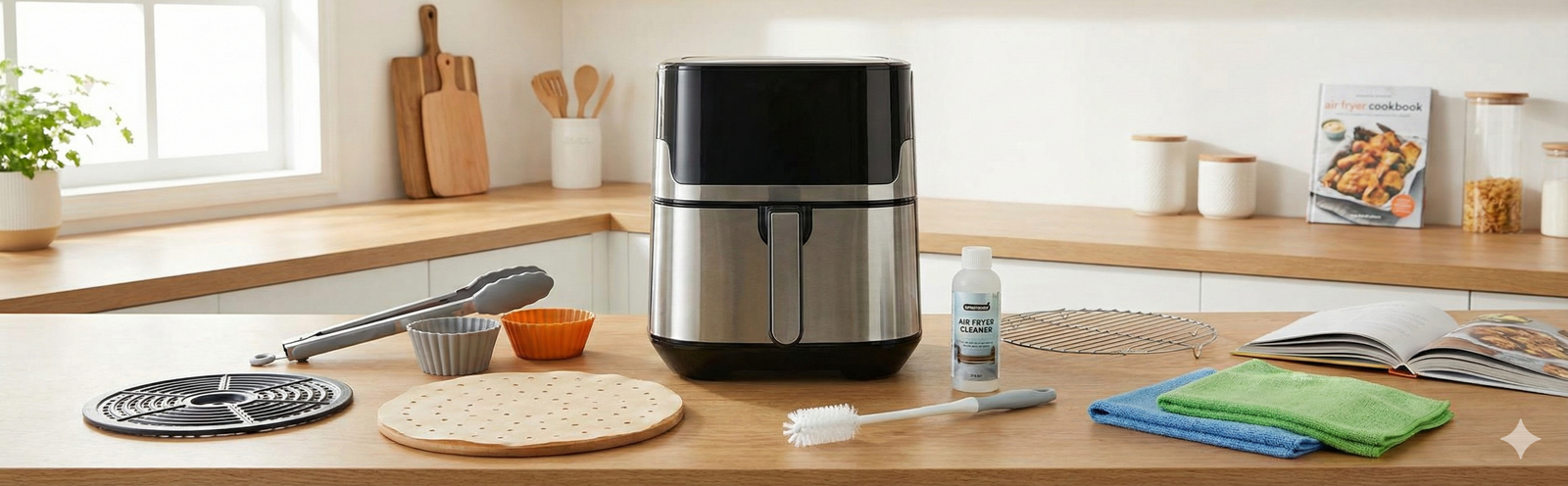
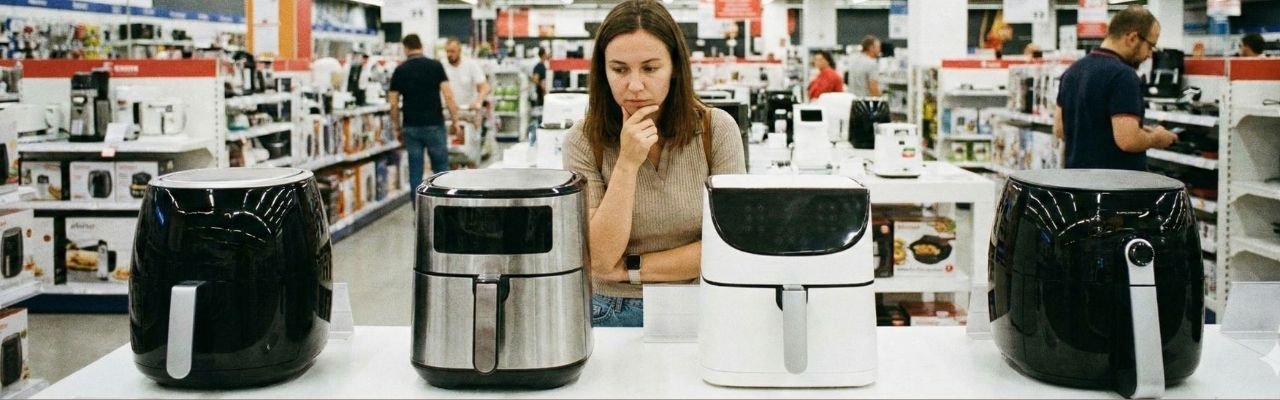
Buying the wrong air fryer usually creates the same pattern: the basket is too small, the controls feel annoying, cleanup takes longer than expected, and the machine ends up living in the back corner of the counter. The right one feels different. It fits the way you actually cook, it handles the portions you make most often, and it is easy enough to use on a random Tuesday when you are hungry and in a hurry.
This guide is a practical, general buying guide for people comparing air fryer sizes, power, cooking styles, and everyday usability. If your decision is mostly about tight counters, limited outlets, smoke concerns, and compact layouts, start with our apartment-specific air fryer guide. If you already know you want ready-to-buy options, jump to our best air fryers under $150 roundup.
Quick answer / TL;DR
For most households, the best first air fryer is a basket-style model in the 4- to 5-quart range with roughly 1400 to 1700 watts, simple controls, and parts that are easy to clean. That size is large enough for everyday meals but still manageable on a normal counter.
- Choose 2 to 3 quarts only if you cook for one person or two light eaters.
- Choose 4 to 5 quarts if you want the safest all-around pick.
- Choose 6+ quarts if you cook family portions, batch meals, or leftovers for more than one day.
- Pay for capacity, airflow, temperature range, and cleanup before you pay for fancy presets.
What this guide covers, and what it intentionally does not
This article answers the broader buying question: how to choose the right air fryer across sizes, feature sets, and normal household use. It is meant to help a shopper understand the decision before getting pushed into a narrow product list. That distinction matters for indexing and for reader usefulness, because not every air fryer shopper has the same intent.
If you are searching with apartment-specific concerns such as limited electrical flexibility, tight counters, minimal clearance, or worry about how an appliance behaves in a smaller living setup, the better next read is our apartment-focused guide. If you are simply asking, “What size, power level, and style should I buy for my household?” then you are in the right place here. That separation keeps each page clearer, more useful, and less repetitive for readers moving through the air fryer cluster.
What an air fryer actually does
An air fryer uses fast-moving hot air to brown and crisp food. In real kitchens, that means it is especially good at foods that benefit from surface crisping: fries, wings, breaded items, vegetables, salmon portions, chicken thighs, and leftovers that turn soggy in a microwave. It is less magical for liquid-heavy recipes, oversized roasts, and meals that need a lot of vertical space.
That matters because many disappointing purchases start with the wrong expectation. People buy an air fryer hoping it will replace every oven, every skillet, and every toaster oven at once. It will not. A good air fryer is a fast weeknight tool. A bad purchase happens when you expect it to be something else.
- Frozen foods and fast comfort meals
- Vegetables that need browning instead of steaming
- Protein portions for one to four people
- Reheating pizza, fries, and breaded leftovers
- Soups, stews, and very wet batters
- Big holiday roasts unless you buy a very large format
- Anyone who never wants another countertop appliance
Why most air fryers disappoint in real life
Most air fryers fail for boring reasons, not dramatic ones. They do not fail because air frying is a bad idea. They fail because the owner picked the wrong size, underestimated the footprint, ignored the cleaning routine, or bought a cheap-looking feature set instead of useful performance. The frustration usually shows up in one of five ways.
- The basket is too small. If two people cannot finish dinner in one batch, the machine quickly becomes annoying.
- The layout is awkward. Some models technically fit the counter but crowd your prep area or hit upper cabinets when opened.
- The controls are overbuilt. Presets sound helpful until they add cost without improving your actual results.
- Cleanup feels like a chore. If the basket, tray, and corners trap grease, usage drops fast.
- The buyer chose by hype instead of routine. A machine that looks impressive can still be wrong for a small household or limited kitchen.
The fix is simple: choose based on your normal week, not your most ambitious weekend. Think about your most common meals, your storage reality, and how often you truly want to preheat a full oven. That is how you buy an air fryer that keeps earning space on your counter.
If you are torn between two sizes, the better question is usually not “Which one is more powerful?” but “Which one will I actually enjoy using twice a week or more?” Convenience drives retention. Retention drives value. The machine that gets used consistently is the right machine, even if a bigger or flashier model looks more impressive on a product page.
The practical buying framework: size first, everything else second
The easiest way to avoid a bad buy is to evaluate an air fryer in this order: capacity, shape, power, controls, cleanup, then price. People often do the reverse. They find a discount, get attracted to a large list of presets, and only later realize the basket is tiny or the machine is too bulky for the kitchen.
1) Start with household size and batch size
The best air fryer size is not just about how many people live in your home. It is about how you portion meals. A single person who meal preps may need more capacity than a couple who mostly reheats snacks. A family that only uses the machine for fries needs something different from a family using it for proteins and vegetables four nights a week.
If your kitchen is tight, do not guess from the listed quart number alone. Check how the machine opens, how much clearance the basket needs, and where the cord will sit. Our guide to air fryer finds for small kitchens is useful when your main constraint is footprint rather than cooking volume. If your pain point is apartment living specifically, ventilation and counter workflow matter just as much as the cooking basket, so the apartment guide is the better companion article.
2) Decide whether basket-style or oven-style fits your routine
Basket-style air fryers are the safest default for most buyers. They usually crisp better, heat faster, and feel more straightforward day to day. Oven-style models can be useful when you want more capacity or more cooking positions, but they are not automatically better. In many homes, they take up extra room without delivering the same easy, punchy airflow that makes air fryers appealing in the first place.
Choose basket-style if you care most about crisping, easy cleanup, and fast weeknight performance. Choose oven-style only if your priority is capacity, tray flexibility, or replacing another small appliance. For first-time buyers, basket-style is usually easier to live with.
3) Treat wattage as a practical performance clue
Wattage is not everything, but it does matter. Lower-powered machines can still work, yet they are more likely to feel slow or less consistent. For many households, the useful middle ground is roughly 1400 to 1700 watts. That usually means better browning, quicker cook times, and less waiting between batches. Once you move higher, you can get faster cooking, but you also need to be realistic about your outlet setup and whether the added power solves a real problem for you.
A practical way to think about it:
- Below 1200W: better for light use, snacks, or compact machines, but less confidence for bigger meals.
- 1400–1700W: the everyday sweet spot for most people.
- 1800W and up: attractive when speed matters, but only worth it if the rest of the machine is equally practical.
4) Pay for features that improve use, not bragging rights
The most useful air fryer features are rarely the flashiest ones. What helps in daily use is a clear basket, a dependable temperature range, controls that make sense at a glance, and parts that do not make cleanup miserable. A huge preset panel is less impressive when you still end up pressing the same two buttons every day.
| Feature | Why it matters | When to skip paying extra |
|---|---|---|
| Simple digital controls | Easy to repeat favorite settings | If you prefer basic knobs and durability |
| Wide basket shape | Better airflow around food than a deep cramped basket | Rarely worth skipping; shape is genuinely important |
| Nonstick or ceramic-coated basket | Lower friction during cleanup | Only if maintenance quality is clearly poor |
| Auto shut-off and cool-touch handle | Safety and ease of use | Do not skip these for a tiny discount |
| Lots of presets | Can be convenient for beginners | Skip paying more when the core design is mediocre |
5) Cleanup decides long-term satisfaction
One of the biggest differences between an air fryer you love and one you regret is how annoying it feels after dinner. Grease splatter, crumbs under a tray, and awkward corners matter more than a fancy name for the fan system. Before buying, think about whether you are realistically going to wipe it down, wash the basket, and put it back often. If not, simplify your choice.
This is also where accessories can help, but only when they are genuinely useful. Our guide to air fryer accessories that actually improve results focuses on the add-ons that make cooking or cleanup easier without turning the machine into drawer clutter.
Who should skip buying an air fryer?
Not everyone needs one. You should probably skip an air fryer, or at least delay buying one, if any of these sound like you:
- You already own a toaster oven or countertop oven that air-fries well enough for your routine.
- You rarely cook frozen foods, vegetables, or quick proteins and mostly use slow cooking methods.
- Your kitchen is so tight that another appliance would create more stress than convenience.
- You expect one machine to replace your full-size oven for every type of meal.
- You hate hand-washing baskets and know you will avoid using anything that adds cleanup.
Skipping is not failure. It is often smarter than buying into a trend that does not fit your space or habits. A good buying guide should help you avoid unnecessary purchases, not just justify them.
Scenario-based recommendations
Once you understand the framework, product selection becomes easier. The models below are not inserted as a giant block at the top because product suggestions only make sense after you know which problem you are solving.
Best fit for one person, a couple, or a genuinely compact kitchen
A smaller air fryer is the right move when you mostly cook snacks, single portions, or small side dishes and you care more about footprint than volume. The key is being honest about whether you are comfortable with batch cooking. If you are, compact units feel convenient instead of limiting.
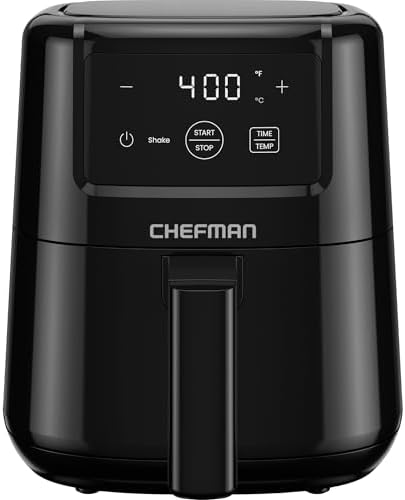
CHEFMAN 2 Qt Mini Air Fryer – Digital Space-Saving Compact Air Fryer
A sensible option for buyers who want a true small-format machine instead of pretending a family-size unit will somehow feel compact on a tiny counter.
- 2-quart format suits singles, couples, and snack-heavy use.
- Digital controls keep the experience simple for a first air fryer.
- Space-saving shape makes more sense than oversizing in a cramped layout.
For more compact-kitchen options beyond a single small model, compare this with the picks in our small kitchen roundup. That article is narrower and more commercial; this guide is about choosing the right format first.
Best fit for most buyers who want one air fryer that just makes sense
This is the sweet spot category. If you are unsure what size to buy, do not overcomplicate it: a well-designed 4- to 5-quart basket-style model is usually the safest recommendation. It handles everyday dinners, leftovers, vegetables, and frozen foods without feeling too big or too limited.

COSORI Air Fryer Pro, Compact 5QT, Ceramic Coating, 7 Presets
This is the kind of size-and-feature balance that works for the broadest group of buyers: enough room for normal meals, easy controls, and less compromise than a mini model.
- 5-quart size lands in the everyday sweet spot for two to four people.
- Simple presets help beginners repeat settings without adding too much friction.
- Ceramic-coated basket design supports easier cleanup after regular use.
If your decision is mostly budget-driven now that you know the right size, our under-$150 air fryer roundup is the better next click because it compares buy-now options rather than teaching the fundamentals.
Best fit for families, meal prep, or buyers tired of tiny batches
A bigger basket makes sense when you repeatedly cook multiple portions or you know small-capacity models will frustrate you. The tradeoff is counter space and handling. Larger air fryers are more useful only if you will actually use the extra room.

Cosori 9-in-1 TurboBlaze Air Fryer 6 Qt, Premium Ceramic Coating
A better match for households that want fewer batches, more room for proteins and sides, and a machine that feels less cramped during meal prep.
- 6-quart capacity makes more sense for families and bigger portions.
- TurboBlaze branding and multi-speed airflow focus on more even results.
- Ceramic-coated basket and tray help keep cleanup practical despite the larger size.
Common buying mistakes that cost more than the air fryer itself
- Buying too small to save space. This sounds disciplined, but it often creates multiple cooking rounds and immediate regret.
- Buying too big because bigger sounds safer. Oversized models can dominate the counter and discourage use in small households.
- Paying for gimmick presets. The best setting is usually the one you can repeat quickly, not the one with the fanciest label.
- Ignoring the shape of the basket. Width often matters more than theoretical volume for crisping.
- Forgetting storage and cable placement. A machine can fit the counter and still feel inconvenient every day.
- Skipping maintenance planning. If you cannot picture how you will clean it after greasy food, you are not done choosing yet.
A realistic setup, cleaning, and maintenance routine
A good maintenance routine is simple. Let the basket cool slightly, remove crumbs after each use, wash the basket and tray before residue hardens, and wipe down the interior area that catches grease. Once in a while, check the heating area for splatter buildup. None of this is difficult, but the more complicated your machine feels, the less likely you are to keep up with it.
A few practical habits go a long way:
- Do not overcrowd the basket if you care about crisping.
- Use a quick shake or flip for foods that brown unevenly.
- Avoid turning accessories into clutter; only keep the ones you actually use.
- Keep the area around the air fryer clear enough for ventilation and basket movement.
- Treat cleanup as part of cooking time, not a separate problem you will solve later.
If you want the shortest path to easier cleanup and better flexibility, our article on accessories that actually improve results is the one to read next. It helps separate useful add-ons from things that look smart online but mostly collect dust.
Are air fryers actually healthier?
They can be, but the honest answer is more practical than the marketing version. Air fryers can reduce added oil and reduce the greasy feel of many foods, which is useful. They also make it easier to cook vegetables, chicken, salmon, and leftovers in a faster, lower-mess way. That said, an air fryer does not automatically turn heavily processed food into a health food. It is a better cooking method for certain jobs, not a nutrition loophole.
In real life, the health advantage is often behavioral: people are more willing to cook a quick meal at home when it is fast, crisp, and easy to clean up. That can lead to better habits than takeout or deep frying, but the machine itself is only part of that equation.
How to judge value without getting trapped by price
The cheapest air fryer is not always the best value, and the most expensive one is not automatically premium in the ways that matter. Good value comes from matching the machine to your actual routine. A cheaper compact model can be excellent value for a single person. The same machine can be terrible value for a family if it creates endless batches and frustration.
Ask yourself these questions before buying:
- Will this size handle my most common meal without feeling cramped?
- Will it fit where I want to use it, not just where I can temporarily store it?
- Are the controls clear enough that I will use it without thinking too hard?
- Does the cleanup look realistic for weeknight use?
- Am I paying for actual convenience or just a longer feature list?
When your answers are clear, price becomes easier to evaluate. If you are now in buying mode instead of research mode, compare current picks in our best air fryers under $150 guide or browse broader kitchen options in our quick comparison of kitchen gadgets.
Choose based on cooking style, not just household size
Two homes with the same number of people can need very different air fryers. That is why “how many people do you cook for?” is only the starting question. What matters just as much is what you cook, how often you cook it, and whether you want an air fryer for speed, crisping, reheating, or all three.
Here is a more realistic way to think about it:
- The snack-and-leftovers user: You mainly want crisp fries, nuggets, pizza slices, and quick freezer food. Capacity matters less than speed and convenience. A smaller or medium basket can be enough.
- The weeknight dinner user: You want to cook vegetables, proteins, and one-pan-style meals without heating the full oven. This is where the 4- to 5-quart range usually wins.
- The batch-cooking user: You cook multiple portions, prep tomorrow’s lunch, or feed several people at once. Bigger capacity matters because repeated batches erase the convenience advantage.
- The limited-space user: You may want the function of an air fryer, but your kitchen only works if the appliance is easy to place, open, and clean. In that case, footprint and lid or basket movement deserve almost as much attention as performance.
When buyers skip this step, they often choose the wrong compromise. They buy small because it looks neat, then get annoyed by constant batch cooking. Or they buy large because they are afraid of regret, then hate the footprint and stop using it. The better move is to match the machine to the problem you are solving most often.
How to compare product pages without getting fooled by marketing language
Air fryer product pages often make several machines sound equally impressive. Almost every listing claims fast cooking, healthier meals, crisp texture, and easy cleanup. That language is too broad to help. Instead of comparing slogans, compare details that change real use.
- Look at the basket shape. A wider cooking area is often more valuable than a deeper one because food crisps best when it is not piled on itself.
- Check the stated capacity against your actual portions. Do not assume the quart number tells the whole story. Think about whether you can fit your usual dinner, not just whether the volume sounds big.
- Notice the control style. A clean digital panel or a straightforward dial setup is better than a cluttered interface you will never use well.
- Pay attention to cleanup clues. Coating, tray design, removable parts, and how the basket is built are more important than trendy feature names.
- Use preset count as a minor factor, not a deciding factor. Presets can be nice, but they should never rescue a bad size or awkward design.
This is also why internal comparison pages matter. A narrow roundup such as our under-$150 guide is more helpful after you already know whether you need a compact, medium, or large format. Buying without that foundation is how people confuse price research with good decision-making.
The one-minute pre-purchase checklist
- Can you picture your most common meal fitting in one batch?
- Do you know where the air fryer will live when you are not using it?
- Does the basket open comfortably in your kitchen layout?
- Are you buying a compact model because it fits your routine or because it looks safer emotionally?
- Are you paying extra for presets you probably will not use?
- Have you chosen between broad buying advice and apartment-specific needs?
- Do you already know which article you will use next: shopping roundup, small kitchens, or accessories?
If you can answer those questions clearly, you are no longer guessing. You are choosing on purpose. That alone improves your odds more than another hour of scrolling through lookalike product listings.
FAQ: how to choose the right air fryer
What size air fryer should most people buy?
Most people should start with a 4- to 5-quart basket-style air fryer. It is the most forgiving balance of capacity, speed, and footprint.
Is a higher wattage always better?
Not always. Higher wattage can help with speed and crisping, but it only matters if the basket size, airflow, and everyday usability also fit your kitchen.
Basket-style or oven-style: which is better?
Basket-style is usually better for crisping, faster cooking, and easier first-time ownership. Oven-style is more niche and makes sense when you specifically need more interior room or tray-style flexibility.
Are compact air fryers worth it?
Yes, if you truly cook small portions and care about saving space. No, if you are buying small only because you are afraid of overcommitting. In that case, you often outgrow it quickly.
Do I need a lot of presets?
Usually not. What matters more is whether the controls are intuitive and whether you can repeat your favorite temperature and time combinations easily.
Can an air fryer replace my oven?
It can replace the oven for many quick meals and reheating jobs, but not for every cooking task. Think of it as a fast specialist, not a universal replacement.
What is the best air fryer for apartments?
That depends more heavily on counter depth, ventilation, and outlet practicality than on quart size alone. For that narrower use case, read our apartment-focused guide.
What should I read next if I already know I want one?
Go to our ready-to-buy air fryer roundup if you want current shopping options, or the accessories guide if you already own one and want better day-to-day results.
Should I buy an air fryer now or wait?
Buy now only if you can clearly name the job it will do in your kitchen: faster weeknight dinners, easier reheating, better frozen foods, or more convenient vegetable cooking. Wait if you are mostly reacting to hype and still cannot define the right size or placement. A short delay is better than buying the wrong format and replacing it later.
Final verdict
If you want the safest air fryer choice with the fewest regrets, buy for your normal week. A medium basket-style model is the best default for most people because it balances portion size, ease of use, and cleanup. Small models make sense when space is the real priority. Large models make sense when batch cooking is the real priority. Almost every bad purchase happens when someone buys for fantasy instead of routine.
And once you know your category, do not keep wandering. Move straight to a narrower comparison page, like our best air fryers under $150 article, so you can compare options that actually fit the framework you just built.
Amazon disclosure: Buyers Choice Lab participates in affiliate programs, including Amazon Associates. If you buy through our links, we may earn a commission at no extra cost to you. That does not change our editorial approach or the way we structure our recommendations.